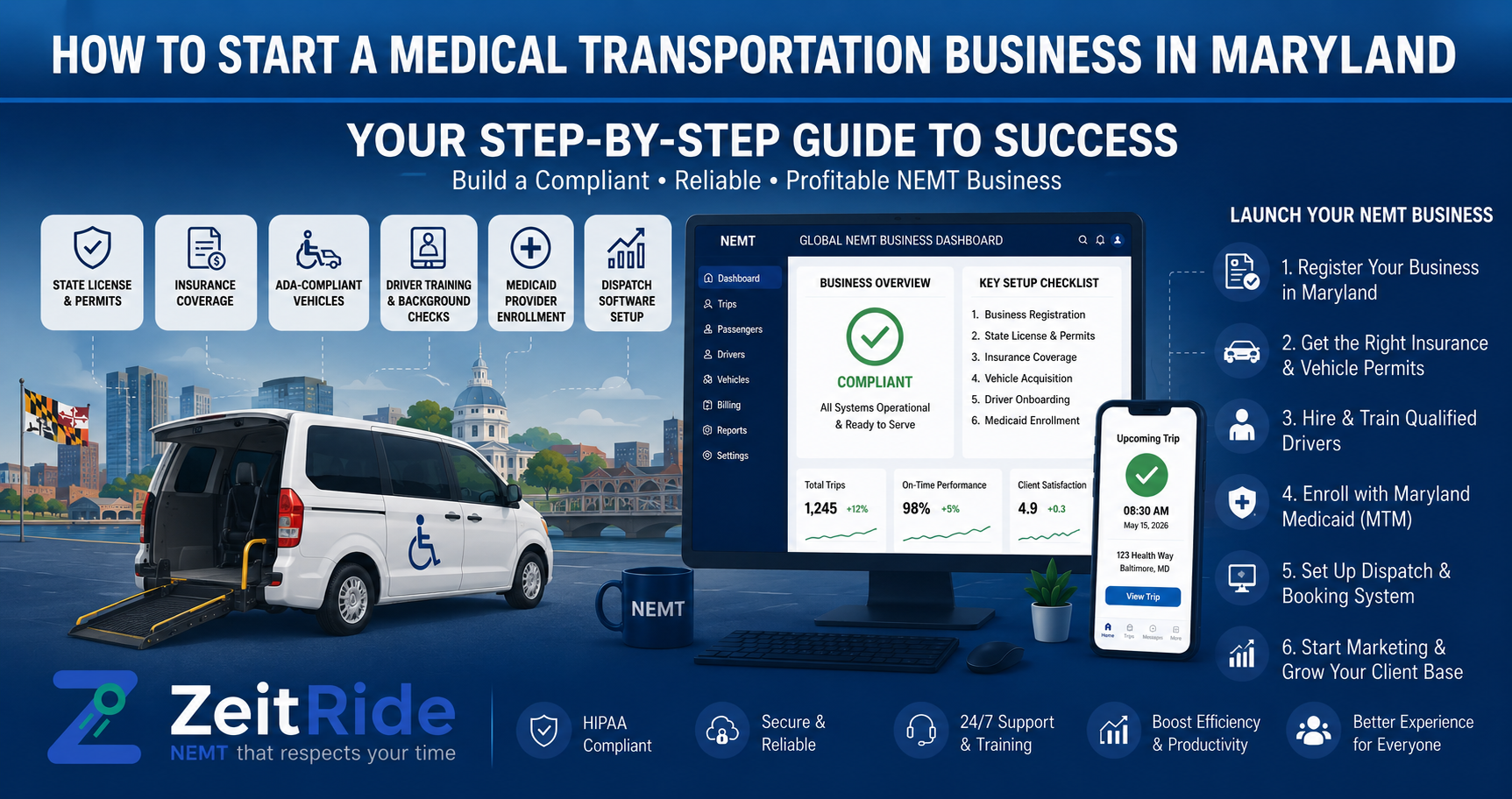
How to start a medical transportation business in Maryland
Maryland runs NEMT county by county, not through one statewide broker. Here's how to start a medical transportation business there — licensing, and software.
Quick answer
To start a medical transportation business in Maryland, register your business entity, get MVA-compliant vehicles and background-checked drivers, and enroll with your county health department for Medicaid NEMT, since Maryland manages NEMT locally rather than through one statewide broker.
ZeitRide Team
NEMT Operations Expert
Figuring out how to start a medical transportation business in Maryland means dealing with a system most states don't use: county-run NEMT instead of one statewide broker. That trips up a lot of new operators before their first vehicle ever hits the road. ZeitRide runs NEMT fleets in 10+ states at $49 per vehicle per month, and the operators who launch cleanest are the ones who understand Maryland's structure before they file a single form.
What starting a medical transportation business in Maryland actually involves
Starting a medical transportation business in Maryland means clearing four separate tracks at the same time: business formation, vehicle and driver compliance, Medicaid enrollment, and operations software. Most new owners treat these as sequential steps. They aren't. Skipping ahead on one while ignoring another is how launches stall for months.
Business formation. Register your entity with the Maryland Department of Assessments and Taxation, get a federal EIN, and set up business insurance — commercial auto liability at minimum, plus general liability if you're transporting anyone with mobility equipment. Most counties also require a local business license before you can operate.
Vehicle and driver compliance. Maryland requires MVA inspection and registration for any vehicle used in for-hire passenger transport, and drivers typically need a clean MVR, a background check, and (for wheelchair-accessible vehicles) documented lift and securement training. If you're doing ambulatory and wheelchair transport, budget for both vehicle types from day one — most brokers request access to both.
Medicaid enrollment. This is where a nemt business plan for Maryland looks different from a plan built for a broker-model state. More on that below.
Operations software. Dispatch, scheduling, routing, and billing all have to work together before your first Medicaid trip gets billed correctly. A lot of new operators buy software after they're already drowning in manual scheduling — it's cheaper and less painful to set this up before your fleet grows.
How ZeitRide solves the operational side of starting a NEMT business
Here's what we've seen from operators launching NEMT businesses across 10+ states: the software decision matters as much as the licensing decision, and it's usually made too late.
ZeitRide gives new and growing fleets one flat-fee platform instead of stitching together separate tools for each function:
- Dispatch and scheduling in one system, so a new trip request doesn't require three different logins
- AI-powered route optimization that averages a 20% reduction in miles driven — meaningful when you're running a lean fleet and every mile costs money
- Automated billing built for broker remittance and Medicaid claims, so you're not manually reconciling trip manifests against payments
- Broker integrations with MTM Health, Provide A Ride, ProCare, DD Med Trans, CTS Transit, and Tennessee Carriers — useful once your county's NEMT program routes through a regional broker or MCO
- A driver app (iOS and Android) with offline GPS and a learning curve under 15 minutes, so new hires are running trips the same day you onboard them
Most providers are live within 30 minutes of signing up, with their first real route dispatched within a day. There's no setup fee, no per-trip charge, and no contract — just $49 per vehicle per month covering the whole platform. Marcus Johnson, owner of Skyline Medical Transport, said the switch saved about a whole day's worth of admin time each week. That's the kind of margin a new operator needs in year one.
NEMT business software vs. the legacy approach
Legacy NEMT platforms like Bambi, Tobi Cloud, RouteGenie, and TripMaster were built around per-seat and per-trip pricing, plus implementation costs that typically run $5,000 to $25,000 before you've dispatched a single trip. For a brand-new NEMT business, that upfront cost competes directly with money you need for vehicles, insurance, and driver hiring.
The bigger issue for new operators isn't the sticker price — it's the mismatch between how these platforms are priced and how a startup fleet actually grows. A per-trip fee punishes you exactly when you're scaling volume, which is the opposite of what a growing business needs. A flat $49 per vehicle means your software cost is predictable no matter how many trips you run this month versus next.
Operators get one other thing wrong at launch: assuming they can add software later once they're "big enough to need it." In practice, manual scheduling and spreadsheet billing become the ceiling on growth, not a temporary inconvenience. Fleets that start with proper dispatch software from day one scale without re-training staff on a new system mid-growth.
Who this is built for
A nemt business plan usually involves several roles wearing multiple hats early on, and the software has to work for all of them:
- Fleet owners who need visibility into every vehicle and route without babysitting a dispatch board
- Dispatch coordinators handling ad-hoc trips, recurring routes, and same-day changes
- Operations directors managing broker relationships and compliance across a growing vehicle count
- Drivers who need a simple app, not a training manual, especially in the first weeks of a new business
Starting a NEMT business in Maryland: the county-based Medicaid model
Understanding how do I become a NEMT provider in Maryland starts with one fact that surprises a lot of new operators: Maryland doesn't run NEMT through a single statewide broker the way most states do. Medicaid NEMT is a fee-for-service benefit administered by the Maryland Department of Health, but day-to-day management is handled at the county level. Most counties operate NEMT through their local health department. Montgomery County is the exception — its Department of Transportation runs the program directly.
That means starting a NEMT business in Maryland requires county-by-county relationship-building, not a single broker application. Depending on where you operate — Baltimore City, Prince George's County, Anne Arundel, or a more rural Eastern Shore county — the contracting process, trip volume, and reimbursement timelines can look different. Urban counties like Baltimore and Montgomery tend to have higher trip density and stricter same-day verification requirements. Rural counties often have longer average trip distances and fewer competing providers, which can mean steadier contract volume for a smaller fleet.
However you enter the market, HIPAA awareness, Medicaid-ready documentation, and EVV (Electronic Visit Verification) support aren't optional extras — they're baseline requirements for staying compliant as a Medicaid transportation provider. ZeitRide's platform is built HIPAA-aware and Medicaid-ready, with encrypted data in transit and at rest and a 99.9% uptime target, so compliance isn't something you bolt on after you're already contracted with a county.
Getting Started
Starting a medical transportation business in Maryland comes down to getting four things right at once: your entity and licensing, your vehicles and drivers, your county-level Medicaid relationships, and the software running your day-to-day trips. ZeitRide covers dispatch, scheduling, routing, and billing for $49 per vehicle per month, with fleets typically running their first live route within a day of setup. Start your first live route within a day. $49/vehicle. No contracts. Book your demo.
Frequently Asked Questions
Q: How do I become a NEMT provider in Maryland?
You register your business with the state, secure MVA-compliant vehicles and background-checked drivers, then apply to provide services through your county's health department or transportation office, since Maryland manages Medicaid NEMT at the county level rather than through one statewide broker. Software that already integrates with brokers like MTM Health and Provide A Ride makes onboarding into any regional contract faster.
Q: How much does it cost to start a NEMT business?
Startup costs vary widely based on fleet size, but expect vehicle acquisition or leasing, insurance, driver background checks, and licensing fees as your core expenses. On the software side, legacy platforms add $5,000–$25,000 in implementation costs, while ZeitRide runs $49 per vehicle per month with no setup fee, which keeps early cash flow available for vehicles and staffing.
Q: What does a NEMT business plan need to include for Maryland specifically?
A Maryland-focused nemt business plan should name the target county or counties, since NEMT contracting happens locally through health departments rather than one state broker. It should also account for vehicle types (ambulatory and wheelchair-accessible), driver hiring timelines, and a software platform that can handle broker billing and trip manifests from launch.
Q: Do I need special licensing to start a medical transportation business in Maryland?
Yes — you need MVA vehicle registration and inspection for for-hire transport, a local business license in most counties, and Medicaid provider enrollment if you plan to bill Medicaid directly or through a broker. Requirements can vary slightly by county, so confirm specifics with your local health department before finalizing your launch timeline.
Q: What software do I need when starting a NEMT business?
At minimum, you need dispatch, scheduling, routing, and billing that work together, since manual coordination across separate tools becomes unmanageable as trip volume grows. ZeitRide covers all four in one $49-per-vehicle platform, including a driver app with offline GPS, so a new fleet can go live within 30 minutes and dispatch its first route within a day.
Rather see it than read about it?
Bring a real route, a couple of drivers, and your current process. 15 minutes, zero pitch.