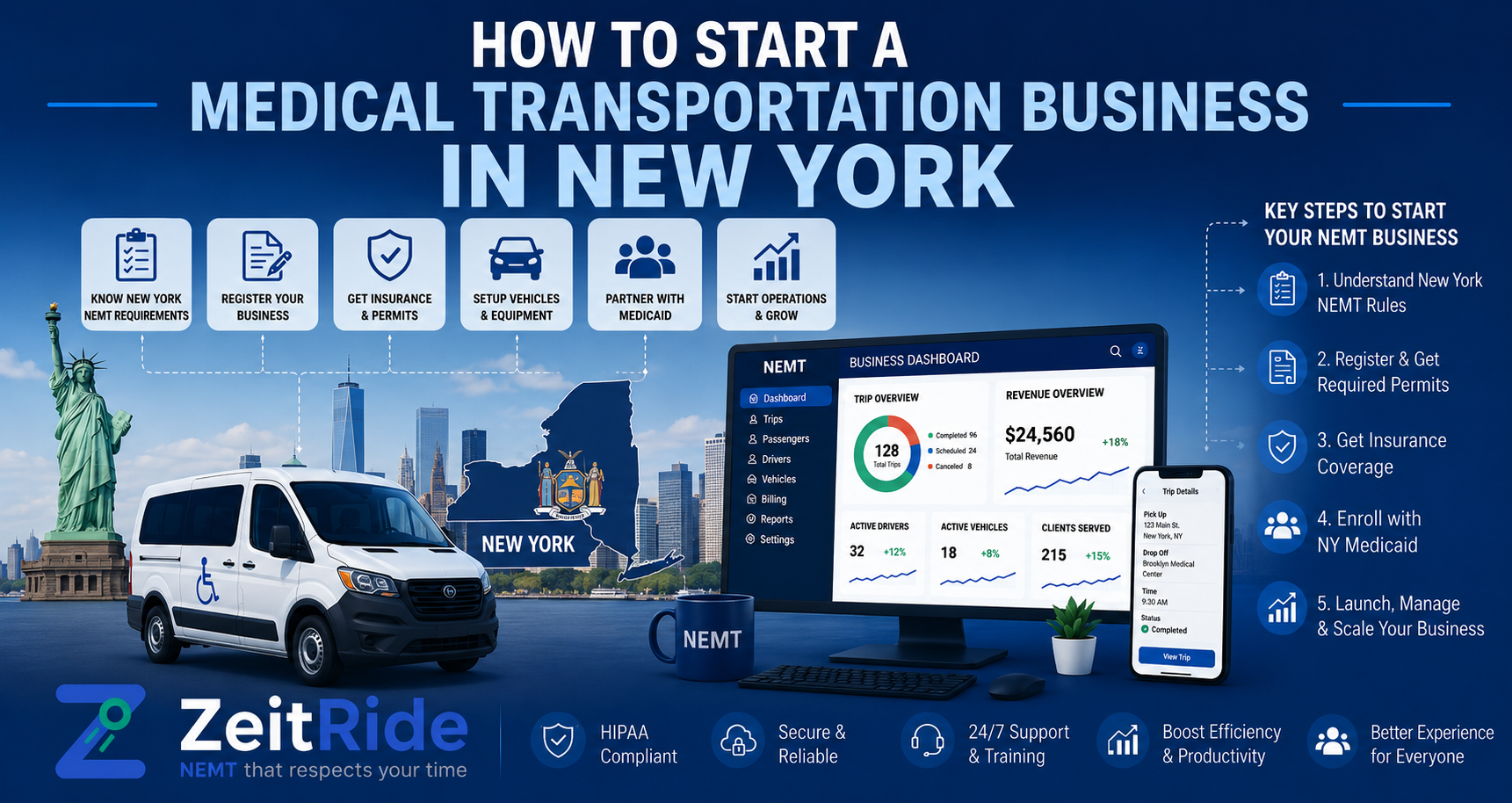
How to start a medical transportation business in New York
Discover how non emergency medical transportation dispatch software streamlines scheduling, routing, driver management, and billing for NEMT providers.
Quick answer
The best non emergency medical transportation dispatch software automates trip scheduling, driver dispatching, route optimization, GPS tracking, billing, and compliance. It helps NEMT providers reduce costs, improve on-time performance, and manage daily operations from one centralized platform.
ZeitRide Team
NEMT Operations Expert
Starting a medical transportation business in New York is one of the more straightforward paths into healthcare services if you know which steps to hit in order. New York has real demand: millions of Medicaid recipients need rides to dialysis, oncology appointments, and specialist visits every week, and the state requires providers meet that need. The operators who build profitable, compliant fleets from day one do it with the right licenses, the right insurance, and NEMT software for small business that doesn't eat their startup budget.
What It Actually Takes to Start a Non-Emergency Medical Transportation Business in New York
To start a non-emergency medical transportation business in New York, you need a registered business entity, a valid NEMT business license, state and county vehicle permits, minimum $1 million auto liability insurance, and enrollment as a Medicaid transportation provider through New York State's Department of Health.
Here's the foundational checklist every new operator in New York needs to work through:
- Register your business entity. Most providers form an LLC for liability protection. File with the New York Department of State and get your EIN from the IRS.
- Obtain an NPI number. Your National Provider Identifier is required to bill Medicaid or work with any managed care broker.
- Apply for a for-hire vehicle (FHV) or livery license. In New York City, vehicles operating as NEMT must be licensed through the NYC Taxi and Limousine Commission (TLC). Outside the five boroughs, check with your county's DMV for commercial vehicle registration requirements.
- Get NEMT-specific insurance. Most New York brokers require at minimum $1 million in commercial auto liability coverage. Wheelchair and stretcher vehicles carry higher premiums — budget accordingly.
- Pass vehicle inspections. Wheelchair-accessible vehicles (WAVs) must meet ADA lift and securement standards. Annual inspections are required.
- Enroll with your county LDSS or managed care broker. Submit the LDSS-3559 or broker-specific enrollment packet and complete any required background checks and driver credentialing.
- Implement HIPAA-compliant recordkeeping. You're handling protected health information on every trip. New York DOH audits providers for compliance, and any software you use must be HIPAA-aware.
Building Your NEMT Business Plan: Vehicles, Costs, and What Profits Actually Look Like
A solid NEMT business plan accounts for vehicle costs, insurance, licensing, staffing, software, and realistic per-trip reimbursement — not just the van payment.
Startup cost ranges for a 1–5 vehicle NEMT operation in New York:
- Vehicle purchase or lease: $25,000–$65,000 per vehicle new (WAVs run higher); used vehicles $10,000–$30,000
- Commercial auto insurance: $5,000–$12,000 per vehicle annually in New York — one of the higher-cost states
- TLC or county licensing: $500–$2,000 depending on jurisdiction
- Vehicle inspection and ADA compliance modifications: $1,000–$5,000 per WAV
- Business registration and NPI: Under $500 combined
- NEMT software: This is where operators make a decision that affects their margins for years
On the software line: legacy platforms like RouteGenie and TripMaster carry implementation costs in the $5,000–$25,000 range, plus per-trip or per-seat fees on top of that. For a startup running five vehicles, that's a significant pre-revenue expense. ZeitRide costs $49 per vehicle per month — $245/month for a five-vehicle fleet — with no setup fee, no annual contract, and broker integrations with MTM Health and Provide A Ride already built in.
On NEMT business profits: Medicaid reimbursement rates in New York vary by county and trip type. Ambulatory trips typically reimburse between $25–$45 per one-way trip. WAV trips run higher, often $45–$80+. A single vehicle running 8–12 trips per day at average reimbursement can generate $80,000–$150,000+ annually before expenses. The operators who reach profitability fastest are the ones whose routes are tight — not the ones with the most vehicles.
See exactly how ZeitRide handles broker imports, route optimization, and Medicaid billing for new providers — no pitch, just your workflow on our platform: explore ZeitRide's NEMT dispatch software.
What New NEMT Operators Get Wrong About Licensing and Software
The most common mistake new operators make when they start a non-emergency medical transportation business is treating licensing and software as sequential problems — get the license, then figure out software later.
What operators also underestimate:
- EVV (Electronic Visit Verification) is now a federal requirement for Medicaid personal care services, and New York has been rolling out EVV mandates that touch NEMT. Software that doesn't support EVV creates compliance exposure from day one.
- Driver credentialing takes time. Background checks, defensive driving certifications, and vehicle-specific training (wheelchair securement, passenger assistance) are all required before a driver touches a Medicaid trip.
- Per-trip fee structures compound fast. A platform that charges $1.50–$3.00 per trip sounds small until you're running 500 trips a month. At that volume you're paying $750–$1,500 monthly on top of base software fees. ZeitRide charges nothing per trip — the flat $49/vehicle/month covers everything.
For a complete look at how NEMT software costs compare across platforms, this breakdown of what NEMT software actually costs covers what most vendors don't put on their pricing page.
Who Should Start a Medical Transportation Business in New York
New York's NEMT market suits several operator profiles — and the startup path looks different depending on which one you are.
First-time business owners entering healthcare transportation do best starting with 2–4 ambulatory vehicles in a single county before adding WAVs. The margins are tighter on ambulatory, but the insurance and vehicle costs are lower, and the broker enrollment process is simpler. ZeitRide's NEMT scheduling software handles recurring and ad-hoc trips from day one — so you're not building manual schedules while also learning compliance requirements.
Existing transportation operators (paratransit, school bus, private limo) who already hold commercial vehicle licenses and insurance have the fastest path to NEMT. Your vehicles may qualify with minimal modification, and your operational infrastructure (dispatch, driver management) transfers directly. The gap is usually broker enrollment and NEMT-specific billing — both of which ZeitRide handles natively with integrations to MTM Health, Provide A Ride, ProCare, and DD Med Trans.
Caregivers or healthcare workers starting a NEMT business are common in New York, particularly in the five boroughs where demand is concentrated. This group typically knows the patient population well but underestimates the operational complexity of managing drivers, routes, and broker remittance simultaneously. ZeitRide's driver app runs on iOS and Android with a learning curve under 15 minutes — drivers are operational the same day you onboard them.
For operators in nearby markets, ZeitRide is also active in Pennsylvania and Florida with state-specific broker integrations in place.
Starting a Medical Transportation Business in New York Is Straightforward If You Don't Skip Steps
Operators who learn how to start a medical transportation business in New York and execute the licensing, insurance, and broker enrollment process in order reach their first Medicaid trip faster and with fewer compliance surprises. The ones who struggle treat software as an afterthought and broker relationships as something to figure out after the vehicles are on the road. ZeitRide is built for fleets entering this market: $49/vehicle/month, broker integrations with MTM Health and Provide A Ride active from day one, HIPAA-aware and EVV-ready, with a 30-minute setup that gets your first route running the same day.
Q: How do I start a medical transportation business in New York?
To start a medical transportation business in New York, register an LLC, obtain an NPI number, get commercial auto insurance with at least $1 million in liability coverage, license your vehicles through the TLC (NYC) or county DMV, and enroll as a Medicaid provider through your county LDSS or a managed care broker like MTM Health or Provide A Ride.
Q: Do I need a special license to start a non-emergency medical transportation business in New York?
Yes. In New York City, NEMT vehicles require a TLC for-hire vehicle license. Outside the five boroughs, you need commercial vehicle registration and county-specific permits. You also need an NPI number and Medicaid provider enrollment to bill for trips. An NEMT business license is distinct from a standard commercial vehicle permit — confirm requirements with your county before purchasing vehicles.
Q: How much does it cost to start a medical transportation business in New York?
Startup costs for a 1–3 vehicle NEMT operation in New York typically range from $40,000–$120,000 depending on vehicle type, insurance premiums, and licensing. WAV vehicles and NYC TLC licensing add to that baseline. Software is a controllable cost: ZeitRide charges $49/vehicle/month with no setup fee, compared to legacy platforms that charge $5,000–$25,000 to implement. See the full NEMT cost breakdown for a line-by-line estimate.
Q: What are realistic NEMT business profits in New York?
A single NEMT vehicle in New York running 8–12 trips per day can generate $80,000–$150,000+ annually in gross revenue before expenses. Net profit depends heavily on route efficiency, insurance costs, and software overhead. Operators who use AI routing to tighten schedules — averaging 20% fewer miles driven — see meaningfully better margins than those running manual dispatch.
Rather see it than read about it?
Bring a real route, a couple of drivers, and your current process. 15 minutes, zero pitch.