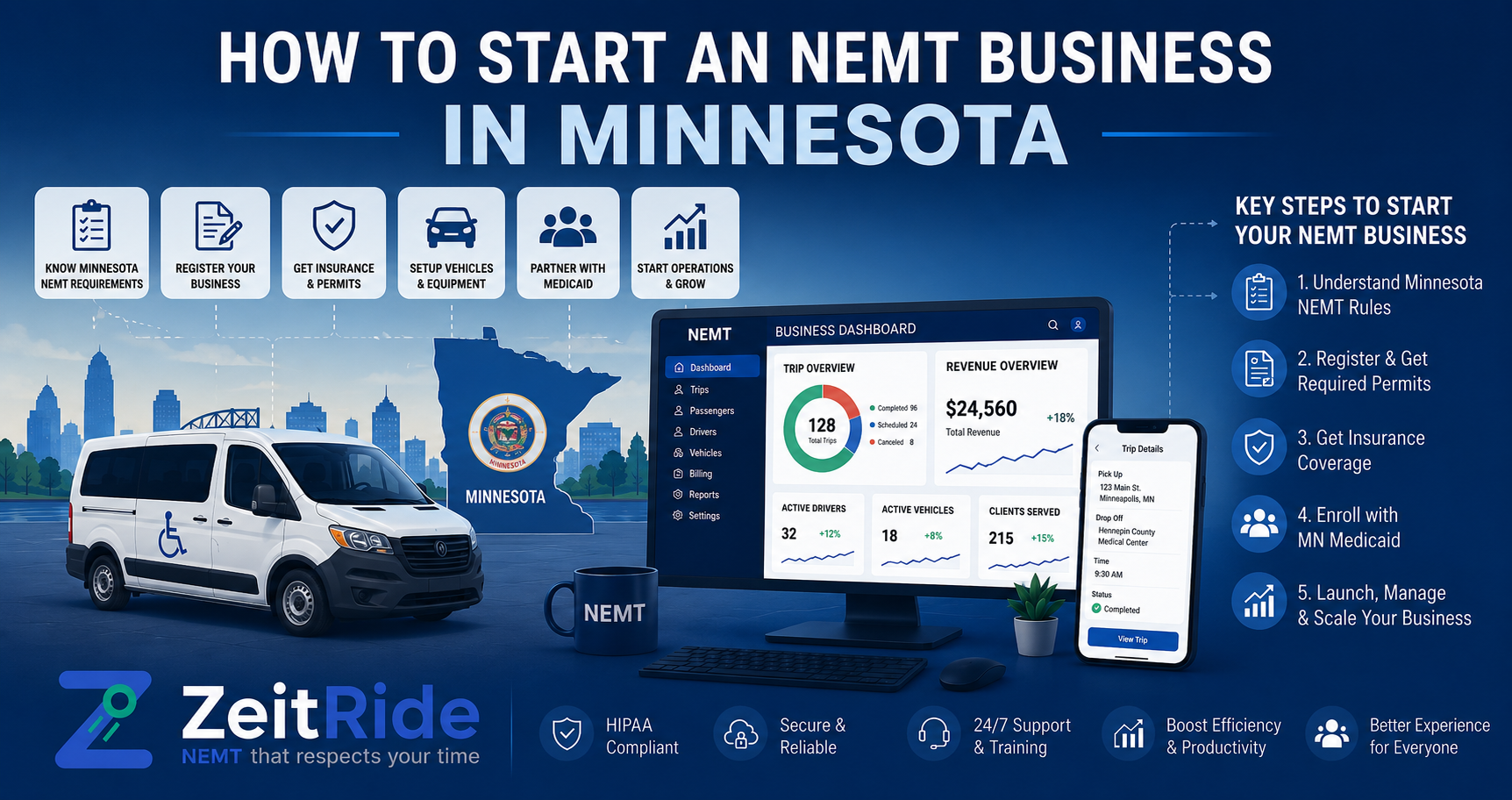
How to Start an NEMT Business in Minnesota
Learn how to start an NEMT business in Minnesota, including licensing, Medicaid brokers, startup costs, compliance, and dispatch software.
Quick answer
To start an NEMT business in Minnesota, register your business, obtain commercial insurance, meet state and Medicaid requirements, build broker relationships, and use NEMT dispatch software to manage scheduling, routing, billing, and compliance efficiently.
ZeitRide Team
NEMT Operations Expert
How to start an NEMT business in Minnesota comes down to learning two systems at the same time: how the state actually pays for rides, and how you're going to run trips once the calls start coming in. Minnesota funds most non-emergency medical transportation through Medical Assistance, the state's Medicaid program, and routes those trips through contracted brokers rather than paying providers directly. That single fact changes how you plan your launch, your budget, and your first month of operations. ZeitRide is dispatch, scheduling, routing, and billing software built for exactly this stage of the business — $49 per vehicle per month, no setup fee, and most accounts running their first live route within a day of signing up.
How to start an NEMT business in Minnesota: the licensing and market basics
Getting a nemt company in minnesota off the ground starts with understanding how the state pays for rides, not just how many rides are out there. Before you buy a single vehicle, you'll need a Minnesota business entity, commercial auto insurance that meets state minimums for passenger transport, driver background checks, and — depending on your county — a local operating permit. None of that is unique to Minnesota, but the Medicaid piece is where most first-time owners lose time.
Vehicle selection matters more than it seems at first. Wheelchair-accessible vans cost more up front and take longer to source, but they open up a wider range of Medicaid referrals than an ambulatory-only fleet. Most operators starting small mix one or two accessible vehicles with a larger share of ambulatory sedans, then scale the accessible fleet as broker volume proves out. Whichever mix you choose, your insurance carrier and your broker contracts will both want to see documentation on vehicle type before they approve you for trip assignments.
Minnesota's Medical Assistance program runs on a managed-care brokerage model. Instead of billing the state directly, most NEMT providers work through contracted transportation brokers who coordinate trip requests, verify Medicaid eligibility, and handle reimbursement. That means your first real business decision isn't fleet size — it's which broker relationships and referral sources you build before you ever pick up a rider. Getting credentialed with a broker typically takes several weeks of paperwork, so it pays to start that process before your vehicles and drivers are fully in place, not after.
Three groups drive most of the demand for a new nemt company in minnesota:
- Senior care and assisted living facilities, concentrated around Minneapolis, St. Paul, and Rochester
- Dialysis clinics, which generate recurring, scheduled trips several times a week per patient
- Hospital systems and outpatient clinics, including major providers around the Twin Cities and Rochester, that need both scheduled and same-day rides
Rural counties in northern and western Minnesota present a different opportunity. There are fewer existing providers, but also less overlap with public paratransit options, which mostly serve the Twin Cities metro. Longer trip distances mean routing efficiency matters more out there than it does downtown — a detail that shapes which software you pick just as much as which broker you sign with.
How ZeitRide solves the operational side of launching in Minnesota
Once you know who you're driving for, the harder question is how you actually run trips without burning your first six months on manual dispatch and a spreadsheet full of broker invoices. ZeitRide handles the day-to-day so a new operator isn't building dispatch, billing, and driver management from scratch.
- Dispatch and scheduling — build recurring routes for dialysis and therapy patients, then slot in same-day trips without breaking the existing schedule
- AI route optimization — trims miles driven by an average of 20%, which matters more in Minnesota's rural counties where trip distances add up fast
- Broker integrations — connects with MTM Health, Provide A Ride, ProCare, and DD Med Trans, so trip imports from Medicaid brokers don't mean re-keying every ride by hand
- Billing — tracks broker remittance and electronic trip manifests so you're not reconciling payments in a spreadsheet at the end of the month
- Driver app — iOS and Android, works offline with GPS, and most drivers are comfortable using it in under 15 minutes, which matters when you're onboarding drivers in rural service areas with spotty cell coverage
What new NEMT operators get wrong in Minnesota
Most first-time NEMT owners in Minnesota make the same mistake: they buy software built for a national fleet before they've booked ten trips.
Legacy platforms like Tobi Cloud and RouteGenie were designed around large, established operators, and their pricing reflects that — often $5,000 to $25,000 in setup costs plus multi-year contracts before you've proven the business works. That's a hard number to justify when you're still figuring out which brokers to work with and whether your rural coverage area can support a second vehicle.
A second common mistake is underestimating how much time manual scheduling costs once broker volume picks up. A single dispatcher juggling phone calls, a paper schedule, and a separate billing spreadsheet can handle maybe a dozen vehicles before something starts slipping — a missed pickup, a duplicate trip, a broker invoice that doesn't match the manifest. That's usually the point where operators either hire a second dispatcher or switch software, and switching software is almost always the cheaper move.
The fix isn't a bigger software budget. It's month-to-month pricing that scales with your vehicle count, not your contract length. ZeitRide runs $49 per vehicle per month, flat, with dispatch, scheduling, routing, billing, and the driver app all included — no per-trip fees and no per-seat charges layered on top. See the full breakdown on the pricing page.
Minnesota-specific compliance and market notes
Minnesota Medical Assistance requires clean NEMT expense tracking, Electronic Visit Verification (EVV) compliance for applicable trip types, and organized broker documentation — all things a nemt company in minnesota needs from day one, not after a compliance audit flags a gap.
A few practical notes for operators building here:
- Twin Cities operators will overlap with metro-area paratransit services for some riders, so it helps to differentiate around Medicaid-eligible trips that paratransit doesn't cover
- Rural and northern Minnesota counties have fewer competing NEMT providers, but longer average trip distances — exactly where route optimization has the biggest impact on fuel costs and driver hours
- Dialysis and outpatient clinic partnerships tend to produce the most predictable, recurring trip volume for a new fleet, since those appointments repeat on a fixed schedule week after week
ZeitRide is HIPAA-aware and Medicaid-ready out of the box, with data encrypted in transit and at rest and a 99.9% uptime target — details that matter when your revenue depends on a broker relationship staying intact.
Getting Started
How to start an NEMT business in Minnesota really comes down to two things: locking in broker and referral relationships early, and running trips on software that doesn't punish you for being small. ZeitRide's flat $49-per-vehicle pricing, 20% average reduction in miles driven, and same-day launch mean a new nemt company in minnesota can be dispatching real trips within 24 hours of signing up — not months into an implementation.
Frequently Asked Questions
Q: How much does it cost to start an NEMT business in Minnesota?
The full answer to how to start an NEMT business in Minnesota on a budget starts with software costs. ZeitRide runs $49 per vehicle per month with no setup fee, compared to the $5,000 to $25,000 in implementation costs common with legacy NEMT platforms.
Q: Do I need a Medicaid broker contract to start a nemt company in Minnesota?
Most Medicaid-funded NEMT trips in Minnesota are coordinated through contracted brokers rather than paid directly by the state, so broker relationships are typically necessary for consistent, funded trip volume from day one.
Q: What software do I need to run an NEMT business in Minnesota?
At minimum, you need dispatch, scheduling, routing, billing, and a driver app. ZeitRide covers all five in one $49-per-vehicle-per-month platform, with integrations for MTM Health, Provide A Ride, ProCare, and DD Med Trans.
Q: How long does it take to get NEMT software up and running?
Most ZeitRide accounts are live within 30 minutes of signing up and dispatch their first route within a day, compared to the multi-week implementations common with legacy NEMT software.
Rather see it than read about it?
Bring a real route, a couple of drivers, and your current process. 15 minutes, zero pitch.