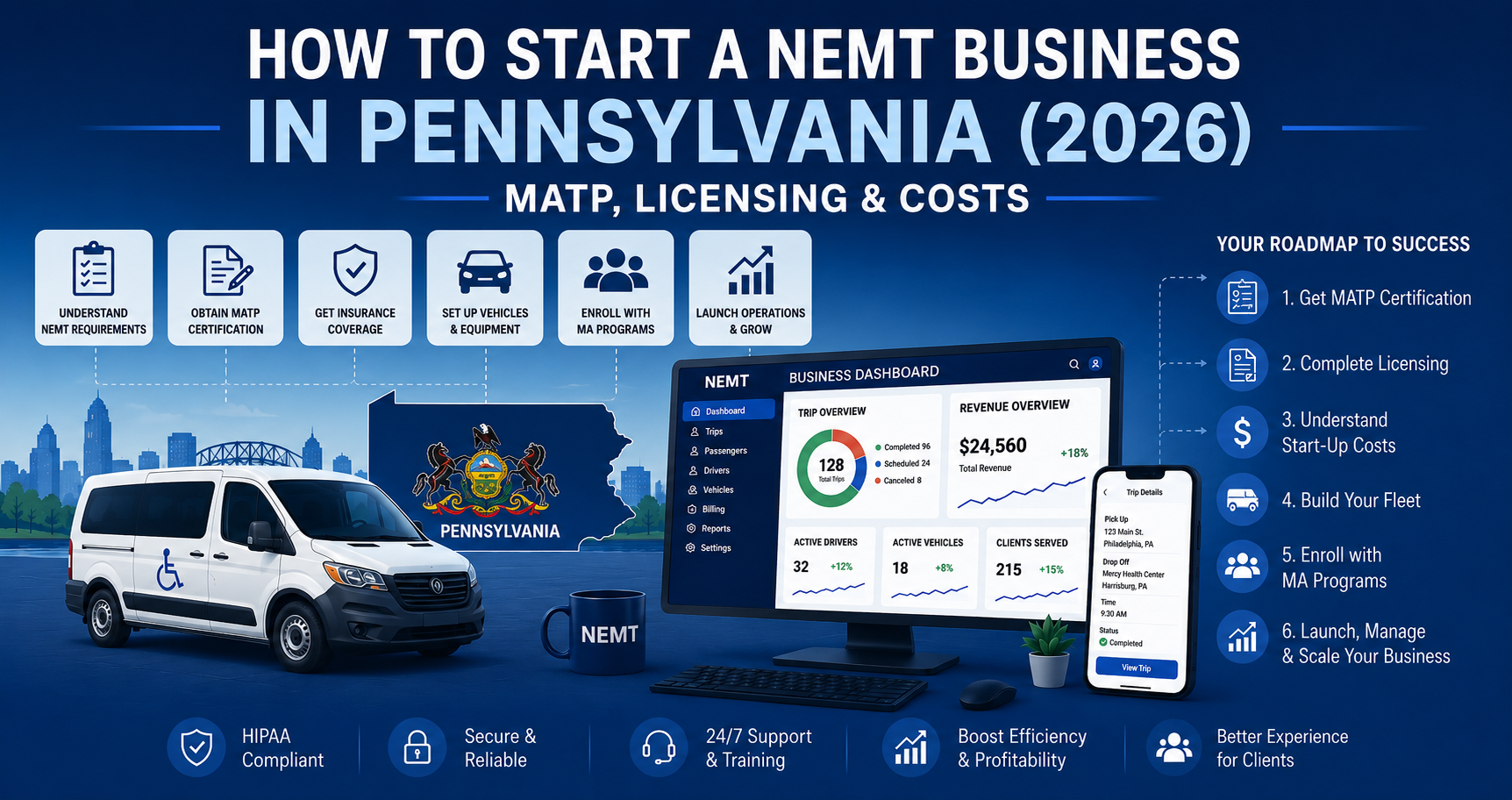
How to Start a NEMT Business in Pennsylvania (2026): MATP, Licensing & Costs
Pennsylvania runs NEMT county by county through MATP — not one statewide broker. Here's the licensing, enrollment, and cost path to launch a PA fleet in 2026.
Quick answer
To start a NEMT business in Pennsylvania, register your company, obtain PUC operating authority, enroll with PROMISe as a Medicaid transportation provider, then contract with your county MATP office — PA runs NEMT county by county, not through one statewide broker.
ZeitRide Team
NEMT Operations Expert
Most guides on how to start a NEMT business in Pennsylvania recycle the same national checklist — form an LLC, buy insurance, get vehicles — and skip the one thing that makes the Keystone State different: Pennsylvania has no single statewide NEMT broker. Medicaid rides here run through the Medical Assistance Transportation Program (MATP), and MATP is administered county by county. That changes how you get licensed, how you enroll, and who actually sends you trips.
This guide covers the full sequence for launching a non-emergency medical transportation business in Pennsylvania in 2026: PUC operating authority, PROMISe™ Medicaid enrollment, county MATP contracting, realistic startup costs, and what established PA operators wish they'd known on day one.
Quick answer: To start a NEMT business in Pennsylvania, register your company and get an EIN and Type 2 NPI, obtain operating authority from the PA Public Utility Commission, enroll as a Medicaid transportation provider through PROMISe, then contract with the MATP office in each county you plan to serve. Budget roughly 8–16 weeks from paperwork to first trip.
How Pennsylvania NEMT Actually Works (There Is No Statewide Broker)
In most states, one contracted broker — ModivCare, MTM Health, or similar — controls Medicaid trip assignment statewide. Pennsylvania is built differently.
The Medical Assistance Transportation Program (MATP) is Pennsylvania's county-administered Medicaid NEMT system: each county government, or an agency it subcontracts, arranges and pays for rides to any service covered by Medical Assistance. Providers therefore enroll county by county rather than through a single statewide application. The program is funded by the PA Department of Human Services and governed by the state's Public Welfare Code, 55 Pa. Code § 2070, and DHS's MATP Standards and Guidelines.
In practice, the entity running MATP looks different depending on where you operate. Some counties run it directly through county human services. Others hand it to a nonprofit or transit operator — Bucks County rides run through Bucks County Transport, Butler County's program is operated by the Alliance for Nonprofit Resources, and Fayette County's runs through FACT. If you've read about Maryland's county-by-county model, Pennsylvania will feel familiar — except MATP is more formalized, with statewide standards layered over local administration.
What this means for your launch plan is simple but non-negotiable: your service area determines your paperwork. A fleet serving three counties may deal with three different MATP administrators, three intake processes, and three billing workflows. Plan for that from day one.
Pennsylvania NEMT License Requirements: PUC and DHS
Two agencies control your right to operate. The Pennsylvania Public Utility Commission (PUC) licenses you as a for-hire motor carrier. The Department of Human Services (DHS) sets the Medicaid-side standards your vehicles, drivers, and documentation must meet. You need both.
Step 1: Set up the business
Register your entity (an LLC is the common choice) with the Pennsylvania Department of State — the Pennsylvania Business One-Stop Hub walks you through registration, tax accounts, and local requirements. Get a free EIN from the IRS, then apply for a Type 2 (organizational) NPI through NPPES. The NPI takes minutes to request and you'll need it for Medicaid enrollment later, so don't leave it for last.
Step 2: PUC operating authority
Most Pennsylvania NEMT companies apply for authority as a motor common carrier of persons in paratransit service. A few details that trip up first-time applicants:
- Use current application forms from the PUC's Motor Carrier Forms page — the PUC stopped accepting older form revisions several years ago, and outdated forms are a common rejection reason.
- Most passenger authority applications carry a $350 filing fee.
- After filing, you must submit binding proof of insurance (an ID card, declaration page, or binder — not a certificate of insurance) within the PUC's deadline, filed electronically by your insurer.
PUC liability minimums scale with vehicle capacity:
| Vehicle capacity | Required liability coverage |
|---|---|
| 15 passengers or fewer | $35,000 split limits, plus first-party medical and wage-loss benefits |
| 16–28 passengers | $1,000,000 combined single limit |
| 29 or more passengers | $5,000,000 combined single limit |
Note that these are PUC floors, not market reality: county MATP programs and managed-care contracts often expect $1M commercial auto, and real-world NEMT insurance costs in 2026 run well above minimum-coverage pricing. Let an insurance lapse and you face civil penalties and surrendering your plates to PennDOT — so treat continuous coverage as an operating requirement, not a renewal chore.
Step 3: Vehicle and driver standards
Every vehicle needs current Pennsylvania registration and inspection, and the PUC requires an updated vehicle list from carriers annually. If you serve wheelchair users, your accessible vehicles must meet lift, ramp, and securement standards, with documentation DHS will review during Medicaid certification. Drivers need a valid PA license, a clean driving record, criminal background checks, and drug screening; most Medicaid-side programs also expect CPR/first aid and passenger-assistance training. Build a complete file per driver before you apply anywhere — every downstream enrollment will ask for it.
Enrolling as a Medicaid Transportation Provider: PROMISe
Here's the step nearly every competing guide skips. A PUC license lets you legally drive passengers for compensation — it does not make you a Medicaid provider. To bill Medical Assistance trips, you enroll in PROMISe™, Pennsylvania's Medicaid provider enrollment and claims system, as a transportation provider.
Enrollment requires your business registration, Type 2 NPI, insurance documentation, and vehicle and driver records — which is why the sequence above matters. With PROMISe active, you can also pursue credentialing with Community HealthChoices (CHC) managed care organizations, which coordinate transportation for many older adults and people with disabilities outside the MATP population. For a fleet that wants full Pennsylvania coverage, PROMISe is the hinge between "licensed carrier" and "paid Medicaid provider."
How to Become a MATP Transportation Provider in Pennsylvania
Short answer: contact the MATP administrator in each county you want to serve, complete their provider intake, and meet DHS's statewide standards — there is no single statewide MATP application.
Because counties administer MATP, becoming a provider is a local process:
- Identify the administrator. The pa.gov MATP page lists every county office. Determine whether your target county runs the program directly or through a subcontracted agency or transit operator.
- Ask for provider requirements in writing. Counties follow DHS's MATP Standards and Guidelines, but intake paperwork, rate structures, and trip-assignment methods vary locally.
- Submit your credential package. Expect to provide PUC authority, insurance certificates naming required parties, vehicle documentation, and complete driver files.
- Understand the trip model. MATP must provide the least costly appropriate ride, so counties mix modes — provider vehicles, transit, and mileage reimbursement. Your volume depends on where provider trips fit in that mix.
- Repeat per county. Each new county is a new enrollment.
A snapshot of how differently counties run the same program:
| County | Who administers MATP & What that means for providers | |
|---|---|---|
| Philadelphia | County program, large urban volume | Highest trip density; most competitive provider landscape |
| Bucks | Bucks County Transport (nonprofit operator) | Provider work flows through an established transit organization |
| Butler | Alliance for Nonprofit Resources | Nonprofit administrator handles intake and scheduling |
| Fayette | FACT (county transportation agency) | Agency mixes provider trips with transit and reimbursement |
| Venango | County human services | Direct county administration, rural route profiles |
(Administrators can change — confirm with the county before building your plan around any row above.)
This fragmentation is also where new PA operators drown in admin work. Three counties can mean three trip-intake formats and three remittance styles landing on one dispatcher's desk — worth knowing before you scale, because it shapes both your staffing and your software decision.
How Much Does It Cost to Start a NEMT Business in Pennsylvania?
Short answer: most small PA fleets launch on roughly $40,000–$90,000 for one to three vehicles — vehicles and insurance dominate the budget. (Estimate; your county, vehicle mix, and insurance history move this significantly.)
| Cost item | Typical 2026 range (estimate) |
|---|---|
| Used wheelchair-accessible van (each) | $15,000–$30,000 |
| Commercial auto + liability insurance (per vehicle, annual) | $4,500–$18,000+ |
| PUC filing and business registration | Under $1,000 |
| Driver screening, training, certifications | $500–$1,500 per driver |
| Dispatch, billing & routing software | From $49/vehicle/month with ZeitRide — no setup fees |
| Working capital (fuel, payroll before remittance) | 2–3 months of operating costs |
Two Pennsylvania-specific notes. First, insurance quotes vary widely by region and driving records — get three quotes before you buy a single vehicle, and see the full national startup cost breakdown for line-item detail. Second, starting with a single van is a legitimate PA strategy: one WAV serving a rural county with limited provider coverage can reach profitability faster than a three-vehicle fleet fighting for Philadelphia volume.
After You're Licensed: Getting Trips and Getting Paid
Licensing gets you to the starting line. Margin comes from what happens next.
Trips. MATP volume builds on reliability — counties route work to providers who show up on time and document cleanly. Many PA fleets also diversify beyond MATP into CHC-MCO trips, facility contracts, and private pay, so one payer's slow season doesn't sink the month.
Documentation. Pennsylvania Medicaid trips demand defensible records: pickup and drop-off times, GPS data, signatures. EVV compliance requirements apply to a growing share of Medicaid transportation, and manual paper logs are the fastest route to denied claims.
Billing. County MATP remittance, MCO claims, and private pay each follow different rules — understanding how Medicaid NEMT billing works before your first invoice cycle protects your cash flow in months two and three, when many startups hit their first crunch.
This is exactly the workload ZeitRide was built for. One platform handles dispatch, county trip intake, driver-app EVV capture, and billing reconciliation — NEMT software built for Pennsylvania fleets, already running operations across the state at a flat $49 per vehicle per month.
What Pennsylvania Operators Say
You don't have to take a software company's word for how PA operations feel at scale. Marcus Johnson, who owns PA Care Transportation, says dispatch that used to consume his day now runs itself once trips are assigned — freeing roughly a full day of his time. Christina Rodriguez, operations director at Chalfont Transportation Services, calls it the easiest system her team has worked with, simple enough to figure out without support tickets. And Aly Taylor, CEO of Lancelot's Multicare Trans, puts it in terms every founder should hear: what mattered wasn't perfection, it was consistent progress and real support — a partner, not just software.
Three operators, three corners of Pennsylvania's fragmented county system, one common thread: the admin burden is beatable with the right operational setup.
Frequently Asked Questions
Q: Do I need a PUC license for NEMT in Pennsylvania?
Yes. Transporting passengers for compensation within Pennsylvania requires operating authority from the PA Public Utility Commission — for most NEMT companies, paratransit-service authority. You'll also need DHS-side certification to serve Medicaid riders.
Q: Is there one statewide NEMT broker in Pennsylvania?
No. Pennsylvania runs Medicaid NEMT through MATP, which is administered county by county — by county governments, subcontracted agencies, or local transit operators. Providers enroll with each county they serve.
Q: How do I become a MATP transportation provider?
Contact the MATP administrator in your target county, complete their provider intake, and submit your PUC authority, insurance, vehicle, and driver documentation. Requirements follow statewide DHS standards, but the process repeats per county.
Q: How much does it cost to start a NEMT business in Pennsylvania?
Most small fleets launch on roughly $40,000–$90,000 for one to three vehicles, driven mainly by vehicle purchases and insurance. Software, filing fees, and registration are comparatively minor line items.
Q: What insurance do PA NEMT providers need?
PUC minimums scale by vehicle capacity, starting at split-limit coverage for vehicles carrying 15 or fewer passengers — but county programs and MCO contracts commonly expect $1M commercial auto liability, and coverage must be continuous with binding proof filed with the PUC.
Q: What is PROMISe enrollment?
PROMISe™ is Pennsylvania's Medicaid provider enrollment and claims system. Enrolling as a transportation provider is what allows your company to bill Medical Assistance trips and pursue managed-care credentialing — a PUC license alone doesn't make you a Medicaid provider.
Bring a Pennsylvania route. We'll run it live.
ZeitRide already powers NEMT fleets across Pennsylvania — dispatch, county trip intake, EVV, driver app, and billing in one platform at $49/vehicle/month. No setup fees, no contracts. Book a 15-minute demo with your own routes: zero pitch, just your workflow running on our system.
Rather see it than read about it?
Bring a real route, a couple of drivers, and your current process. 15 minutes, zero pitch.