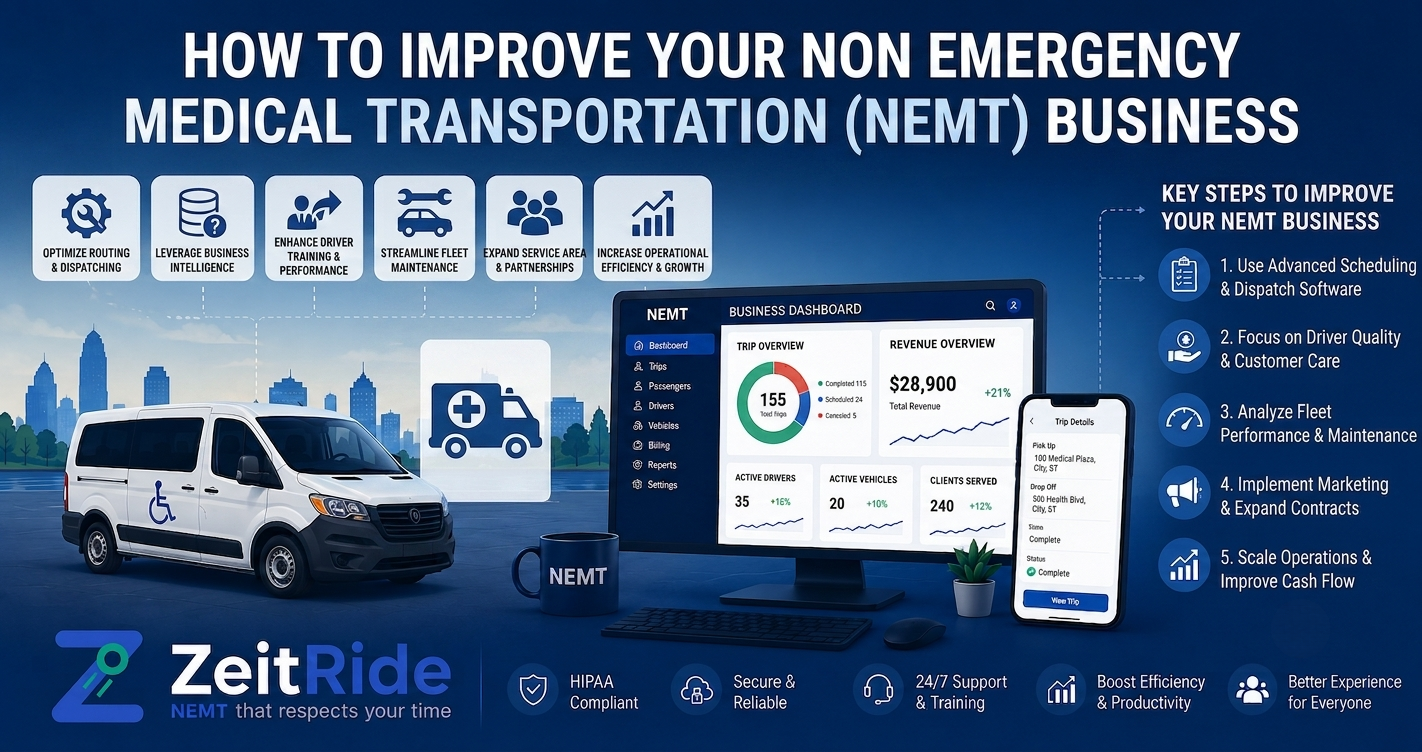
How to improve your Non Emergency Medical Transportation business
Late pickups, missed billing, and broker complaints usually trace back to one thing: how you're scheduling trips. Here's how to fix it.
ZeitRide Team
NEMT Operations Expert
If you're looking for how to improve your Non Emergency Medical Transportation business, the answer usually isn't more drivers or more marketing it's fixing what happens between a trip getting booked and a driver showing up. Late pickups, double-booked vehicles, and billing errors are the three complaints that lose broker contracts fastest, and all three trace back to how trips get scheduled. ZeitRide fixes that with one platform $49 per vehicle per month — that handles scheduling, routing, and billing together, and fleets running it average a 20% cut in miles driven.
What Actually Holds a NEMT Business Back
Most NEMT Business growth problems aren't sales problems — they're operations problems wearing a sales costume. A fleet that's losing broker trips usually isn't losing them to a competitor with better marketing. It's losing them because pickups run late, because a dispatcher double-booked a vehicle, or because a broker's compliance audit turned up missing trip records.
Non-Emergency Medical Transportation runs on trust between three parties — the broker, the member, and the fleet — and trust breaks fastest at the scheduling layer. A dispatcher juggling a whiteboard and a phone can hold together five or six vehicles. Past that, the math gets too complex to do by hand: mobility equipment, appointment windows, will-call return trips, and broker deadlines that can be as tight as 15 minutes.
The pattern shows up the same way across most fleets that stall out around 8 to 15 vehicles. Growth adds trip volume faster than it adds dispatcher capacity, so the dispatcher starts reacting instead of planning — fielding calls about late pickups instead of building tomorrow's route in advance. That reactive mode is expensive in ways that don't show up on a P&L right away: a broker quietly routes fewer trips to a fleet with a pattern of late pickups, long before they cancel the contract outright.
How ZeitRide Solves the Operations Side of Growing a NEMT Business
ZeitRide addresses the scheduling, billing, and compliance problems that quietly cap growth before marketing even matters:
- AI route optimization — recalculates every driver's route in real time when a trip changes, so a late cancellation doesn't mean rebuilding the whole board by hand.
- Broker import — pulls trip batches directly from MTM Health, Provide A Ride, ProCare, and DD Med Trans instead of a dispatcher retyping each trip from a portal
- Automatic EVV and manifests — every completed trip generates its electronic visit verification record, so a broker audit doesn't mean pulling paper logs the night before.
- Built-in billing — broker remittance and private-pay collection through Stripe run off the same completed-trip data, cutting the reconciliation work a bookkeeper does by hand.
- Driver app — iOS and Android, offline GPS, and a learning curve most drivers clear in under 15 minutes, so a new hire is running real routes on day one.
What NEMT Operators Get Wrong About Growing the Business
The most common mistake is chasing more trip volume before fixing the operations that would let a fleet handle more trips without breaking. Adding vehicles onto a scheduling process that's already stretched thin just means more late pickups, not more revenue. A sixth vehicle doesn't help if the dispatcher is already two hours behind by 9 a.m.
The second mistake is judging NEMT software purely on the monthly subscription price. Legacy providers like RouteGenie, TripMaster, and Bambi often carry $5,000 to $25,000 in setup fees plus per-trip or per-seat charges that scale against you as you grow — the opposite of what a growing fleet needs. ZeitRide runs month-to-month at a flat $49 per vehicle, with no setup fee and no per-trip charge, so adding three vehicles in a strong month doesn't mean a new contract negotiation.
The third mistake is treating compliance as paperwork instead of a growth lever. A fleet with clean EVV records and on-time manifests is the fleet a broker calls first when new trip volume opens up. A fleet that scrambles to reconstruct records during an audit is the one that gets quietly deprioritized, even if the driving itself was fine.
Who This Is Built For
Improving a Non Emergency Medical Transportation Business means giving every role the tools to do their part without stepping on someone else's workflow:
• Fleet owners get a real-time view of revenue per trip and vehicle utilization without pulling a report or calling the office. • Dispatchers get a schedule that reflows itself when a trip changes, instead of manually rebuilding the board. • Operations directors get compliance records — EVV logs, manifests, broker remittance data — generated automatically instead of assembled the night before an audit. • Drivers get a phone app with offline GPS and turn-by-turn routing instead of a printed sheet from the morning meeting.
Every role works off the same trip data in real time, which is what actually moves a fleet from surviving broker audits to winning bigger contracts — brokers notice which providers show up on time and pass compliance checks cleanly, and they route more volume to them.
This matters most for fleets running mixed contracts — Medicaid broker trips alongside private-pay bookings, sometimes with a facility contract layered on top. Trying to track all three in separate systems usually means a dispatcher reconciling three calendars by hand at the end of the week, and something eventually slips. One shared schedule means a private-pay trip booked through Stripe sits in the same queue as a broker-imported Medicaid trip, routed by the same engine and billed through the same system.
Final Word
Improving a Non-Emergency Medical Transportation business comes down to fixing scheduling, billing, and compliance before chasing more trip volume. ZeitRide fleets cut miles driven by 20% on average and get their first live route running within a day, all for $49 per vehicle per month with no setup fees or contracts.
Frequently Asked Questions
Q: How do I improve my Non Emergency Medical Transportation business?
Start with scheduling, since late pickups and double-booked vehicles cause most broker complaints. ZeitRide's route optimization and broker import cut that manual work and average a 20% reduction in miles driven per vehicle.
Q: What's the biggest reason NEMT businesses lose broker contracts?
Late pickups and failed compliance audits are the two most common reasons. Automated EVV records and manifests, built into ZeitRide at $49 per vehicle per month, remove the manual paperwork that usually causes audit failures and gives brokers a clean record to check against.
Q: How much does NEMT software cost?
Legacy providers often charge $5,000 to $25,000 in setup fees plus per-trip charges. ZeitRide charges a flat $49 per vehicle per month with no setup fee and no contract.
Q: Does NEMT software integrate with Medicaid brokers?
Yes — it should pull trip batches directly from brokers instead of requiring manual entry. ZeitRide integrates with MTM Health, Provide A Ride, ProCare, and DD Med Trans.
Q: Is NEMT software HIPAA compliant?
It needs to be, since trip data includes member health and mobility information. ZeitRide encrypts data in transit and at rest and is built HIPAA-aware and Medicaid-ready.
Rather see it than read about it?
Bring a real route, a couple of drivers, and your current process. 15 minutes, zero pitch.