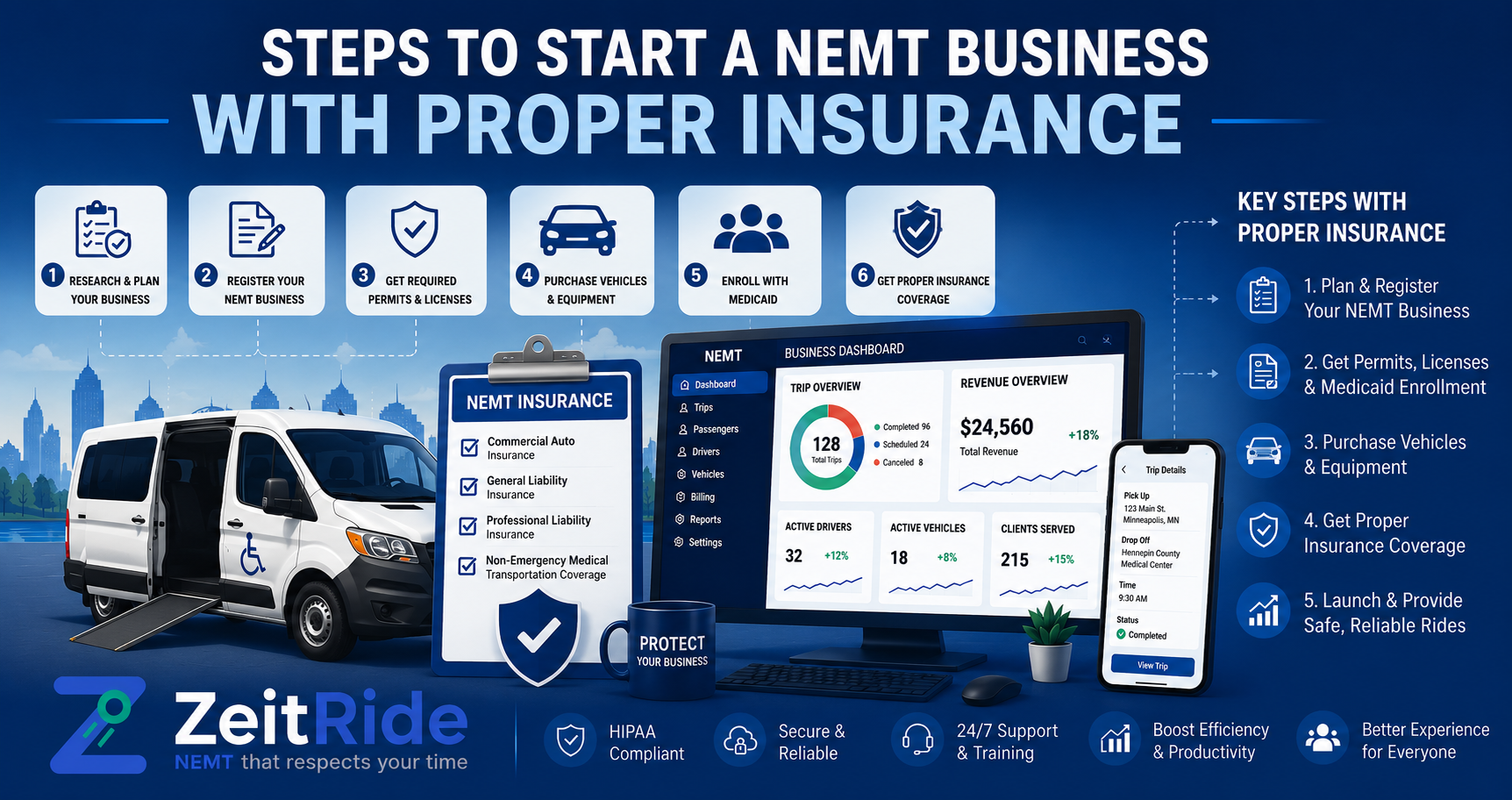
Steps to start a NEMT business with proper insurance
Start a NEMT business with proper insurance by securing commercial coverage, permits, and broker-ready documentation before launching.
Quick answer
To start a NEMT business with proper insurance, form your business, secure commercial NEMT insurance, obtain state permits, and complete broker credentialing before launching. Using compliant dispatch and billing software also helps meet broker and Medicaid requirements.
ZeitRide Team
NEMT Operations Expert
The steps to start a NEMT business with proper insurance are the difference between a fleet that lands broker contracts and one that gets rejected after its first credentialing review. Most new owners register an LLC, buy a used minivan, and treat insurance as an afterthought — then find out their policy doesn't meet a broker's coverage minimums. ZeitRide runs dispatch, scheduling, routing, and billing for NEMT providers across 10+ states, and the pattern is always the same: insurance and back-office readiness decide whether launch day actually happens.
What Starting a NEMT Business the Right Way Actually Involves
Learning how to start a NEMT business means treating it as a regulated transportation company first and a driving job second. A NEMT business plan has to account for state licensing, vehicle permitting, Medicaid broker credentialing, driver qualification files, and — above everything else — an insurance program that matches what brokers actually require before they'll send you a trip.
Most guides on how to start a NEMT business focus almost entirely on vehicles and branding. The operators who actually get approved for broker contracts spend more time on insurance, permitting, and documentation than on picking a fleet color.
Here's the sequence that holds up in practice:
- Write the NEMT business plan. Define your service area, target brokers (MTM Health, Provide A Ride, ProCare, DD Med Trans), vehicle mix (ambulatory, wheelchair, stretcher), and startup budget.
- Form the legal entity and get an EIN. Most operators choose an LLC for liability separation.
- Secure commercial NEMT insurance before you touch a vehicle. This step gets skipped constantly, and it's the one that stalls broker onboarding the longest.
- Register vehicles under commercial use, not personal auto. Personal policies exclude paid passenger transport entirely.
- Apply for state transportation permits and Medicaid provider enrollment.
- Set up dispatch, scheduling, and billing software so trip records, EVV timestamps, and claims are broker-audit-ready from day one.
- Hire and credential drivers, including background checks, driving history, and any state-mandated passenger-assistance training.
- Run your first live route once insurance certificates, permits, and software are confirmed together — not one at a time.
The Insurance Program Every NEMT Business Needs
A NEMT business carries more insurance exposure than a standard livery or rideshare operation because the passengers are medically vulnerable. Proper insurance for a NEMT business typically includes:
- Commercial auto liability, sized to your state and broker minimums — often well above personal auto limits.
- General liability, covering incidents outside the vehicle, like a fall during a wheelchair transfer.
- Workers' compensation, required in most states once you employ drivers.
- Umbrella or excess liability, which brokers increasingly require on top of primary auto coverage.
- Passenger accident/medical payments coverage, specific to transporting medically fragile riders.
Ask any agent who's underwritten this space and they'll tell you the same thing: insurers want to see how trips are documented, not just how many vehicles you own. That's where dispatch software becomes part of the insurance conversation, not a separate purchase. ZeitRide's nemt billing software keeps trip manifests, GPS timestamps, and driver records in one place, which is exactly the documentation an underwriter or a broker auditor asks for during renewal or credentialing review.
How ZeitRide Fits Into Your NEMT Business Startup Plan
ZeitRide isn't insurance, but it's the operational backbone that makes your insurance program defensible and your broker onboarding faster. Here's what a new NEMT business gets running on the platform:
- Flat $49-per-vehicle-per-month pricing — no setup fees, no per-trip charges, no annual contract, so your NEMT business plan has a predictable software line item from day one.
- Dispatch, scheduling, routing, and billing in one system, so you're not stitching together three vendors before you've run a single trip. See the full feature set.
- AI route optimization that averages a 20% reduction in miles driven, which matters when every mile is a fuel cost you're modeling in your startup budget.
- A driver app for iOS and Android with offline GPS and under a 15-minute learning curve, so new hires are running routes the same day they're credentialed.
- HIPAA-aware, Medicaid-ready, EVV-supported infrastructure, encrypted in transit and at rest — the documentation layer brokers and insurers both want to see.
- Broker integrations with MTM Health, CTS Transit, Provide A Ride, ProCare, DD Med Trans, and Tennessee Carriers, so trip imports don't require manual re-entry.
Most providers go live within 30 minutes of setup and run their first route within a day, which means the software side of your launch timeline isn't the bottleneck — insurance and permitting usually are.
What NEMT Operators Get Wrong About Insurance and Startup Costs
The most common mistake in a NEMT business plan is budgeting for vehicles and drivers, then treating insurance and software as line items to figure out later. Both belong in the initial cost model, not the "next quarter" list.
How much does it cost to start a NEMT business? The honest answer is that it depends heavily on fleet size, state minimum coverage requirements, and whether vehicles are purchased, financed, or leased — but insurance premiums, permitting fees, and software are recurring costs that need to be modeled monthly, not as one-time startup expenses. Operators who only calculate how much it costs to start a NEMT business based on vehicle purchase price consistently underbudget by a wide margin once insurance renewals and broker compliance requirements come due. ZeitRide's pricing lays out the flat per-vehicle rate so that line item, at least, is fixed from month one.
Legacy NEMT software makes this worse. Platforms like Bambi, RouteGenie, and TripMaster often carry setup costs in the $5,000–$25,000 range plus per-seat or per-trip fees, which stacks on top of insurance premiums during the exact window when a new NEMT business has the least cash flow flexibility. A flat $49-per-vehicle rate with no setup fee removes one variable from that budget instead of adding to it.
A Realistic Timeline for How to Start a NEMT Business
Operators asking how to start a NEMT business usually want a timeline, not just a checklist. In practice, the sequence runs in three overlapping phases rather than one straight line:
- Weeks 1–3: Entity, insurance quotes, and business plan. File your LLC, request commercial NEMT insurance quotes from at least two carriers, and finalize your NEMT business plan, including target brokers and vehicle mix.
- Weeks 3–6: Permitting, vehicle registration, and software setup. Bind your insurance policy, register vehicles commercially, apply for state transportation permits, and get dispatch and billing software running so trip documentation is ready before your first broker call.
- Weeks 6–10: Broker credentialing and driver onboarding. Submit broker applications with proof of insurance and EVV-capable software, background-check and train drivers, and schedule your first live routes.
Insurance underwriting and Medicaid broker credentialing are almost always the longest steps in how to start a NEMT business, not vehicle acquisition or software setup. Budgeting extra time for both prevents a launch date from sliding by weeks.
Conclusion
Getting the steps to start a NEMT business with proper insurance right the first time is what separates operators who pass broker credentialing from those stuck resubmitting paperwork for months. Between commercial auto coverage, general liability, and EVV-compliant documentation, insurance and software readiness are the two pieces that decide your launch date. ZeitRide gets most new providers live within 30 minutes and running real routes within a day.
Frequently Asked Questions
Q: What are the first steps to start a NEMT business with proper insurance?
Write a NEMT business plan, form your legal entity, and secure commercial NEMT insurance before registering vehicles or applying for broker credentialing. Insurance has to be in place before permits and broker applications move forward, since most credentialing reviews ask for proof of coverage upfront.
Q: How much does it cost to start a NEMT business?
Costs vary by fleet size and state, but expect vehicle acquisition, commercial insurance premiums, permitting fees, and software as ongoing monthly costs rather than one-time expenses. ZeitRide's flat $49-per-vehicle-per-month pricing keeps the software portion of that budget predictable.
Q: What insurance does a NEMT business need?
A NEMT business typically needs commercial auto liability, general liability, workers' compensation, umbrella coverage, and passenger accident coverage, sized to state and broker minimums. Documentation from your dispatch software often supports the underwriting and renewal process.
Q: Do I need special insurance for wheelchair or stretcher vehicles?
Yes. Vehicles equipped for wheelchair or stretcher transport typically carry higher liability exposure and may require endorsements beyond standard commercial auto coverage. Brokers frequently verify this coverage as part of credentialing.
Q: How long does it take to start a NEMT business?
Timelines depend on state permitting and insurance underwriting more than software setup. ZeitRide providers go live within 30 minutes of onboarding and run a first route within a day, but insurance issuance and Medicaid broker credentialing typically take several weeks.
Rather see it than read about it?
Bring a real route, a couple of drivers, and your current process. 15 minutes, zero pitch.