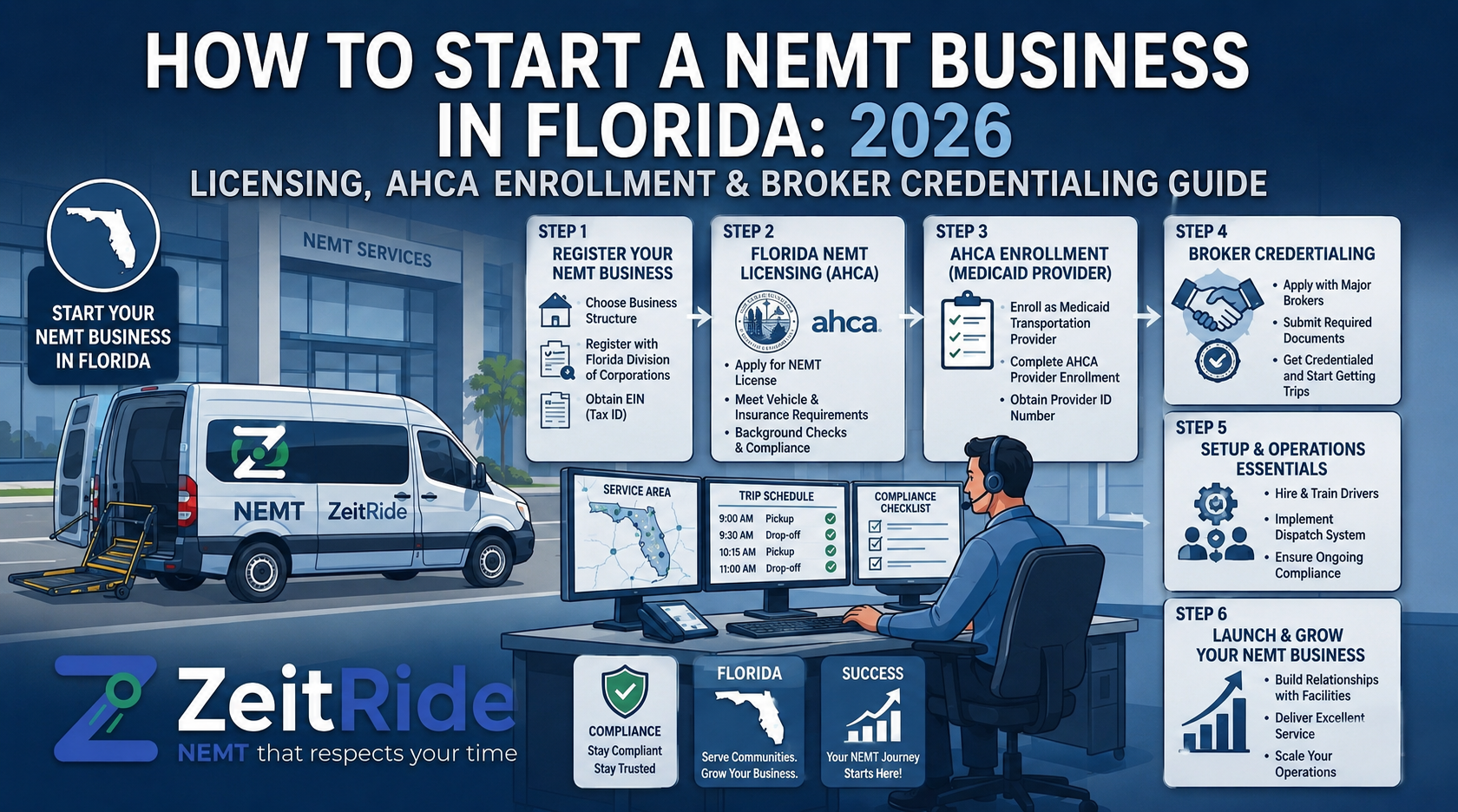
How to Start a NEMT Business in Florida: 2026 Licensing, AHCA & Broker Guide
Florida's AHCA enrollment, county licensing, and broker credentialing — what it actually takes to launch an NEMT business in Florida in 2026.
Quick answer
To start an NEMT business in Florida, register your LLC through Sunbiz, get an EIN, check your county's local permit rules, secure commercial auto and liability insurance, enroll as a Medicaid provider through AHCA, get credentialed with brokers like ModivCare and MTM, and equip ADA-compliant vehicles before accepting trips.
ZeitRide Team
NEMT Operations Expert
Florida is one of the largest Medicaid NEMT markets in the country, but it's also one of the more confusing states to get licensed in — not because the paperwork is unusually hard, but because Florida runs a hybrid system that trips up nearly every first-time operator. If you're researching how to start a NEMT business in Florida, the honest starting point is understanding that you're not dealing with one agency and one broker. You're dealing with a state Medicaid agency, a network of managed care plans, and the brokers each of those plans contracts with — and getting that structure straight before you file anything will save you weeks.
Short answer: To start an NEMT business in Florida, you'll register your business through Sunbiz, get a federal EIN, check whether your county requires a local transportation or business permit, secure the insurance brokers will require, enroll as a Medicaid provider through Florida's Agency for Health Care Administration (AHCA), get credentialed with the Medicaid managed care brokers operating in your area (commonly ModivCare and MTM), and prepare ADA-compliant vehicles and screened drivers before you can accept your first trip. The realistic timeline runs 8–14 weeks from formation to first billed trip, depending on how quickly your county and broker credentialing clear.
Why Florida Is Worth the Paperwork
Florida's Medicaid program covers a large and growing share of the state's residents, and the state's age profile is part of why NEMT demand stays steady here in a way it doesn't in younger states. Florida consistently ranks among the states with the highest share of residents aged 65 and older in the country, and that population drives a disproportionate share of recurring NEMT volume — dialysis, oncology follow-ups, and routine specialist visits that happen on a predictable schedule. That predictability is exactly what makes Florida attractive to a new operator: once you're credentialed with even one broker, recurring dialysis and treatment routes tend to fill a schedule fast. The tradeoff is that Florida's compliance path has more moving parts than a single-broker state, which is the part most guides understate.
How Florida's NEMT System Actually Works (AHCA, MCOs & Brokers)
This is the section that determines whether the rest of your application process makes sense, so it's worth slowing down here. Florida administers Medicaid through the Agency for Health Care Administration (AHCA). Most Medicaid recipients in Florida are enrolled in a managed care plan under the Statewide Medicaid Managed Care (SMMC) program, and NEMT is a "carved-in" benefit — meaning the managed care plan, not AHCA directly, is responsible for arranging a recipient's rides. A smaller share of recipients who aren't enrolled in a managed care plan get transportation directly through AHCA's fee-for-service process. In practice, this means:
- If you want to serve managed care members, you need to get credentialed with the broker(s) that the relevant managed care plans use in your service area — most commonly ModivCare and MTM.
- If you want to serve fee-for-service recipients, you go through AHCA's own enrollment and broker arrangement directly.
- Most serious Florida operators end up credentialing with more than one broker to access the full addressable population in their county, since plan and broker assignments vary by region.
Before you fill out a single application, find out which managed care plans and brokers are active in the specific county or counties you plan to serve — this single piece of research will shape every step that follows.
Step 1 — Register Your Business and Get Your EIN
Register your business entity (most operators choose an LLC for liability protection) through the Florida Division of Corporations, commonly known by its filing portal, Sunbiz.org. Once your entity is approved, apply for a federal Employer Identification Number (EIN) through the IRS — this step is free and typically processes within days online. If you intend to bill Medicaid or any broker directly, you'll also need a National Provider Identifier (NPI), which you can apply for through the federal NPPES system at no cost.
Step 2 — Check Your County's Local Licensing Rules
This is the step most general guides skip, and it's the one that catches new Florida operators off guard. Florida does not run NEMT licensing as a single statewide permit process the way some states do — local counties and municipalities can layer on their own registration or permit requirements on top of state and Medicaid rules. Practically, that means:
- Some counties process NEMT-adjacent business registration through a local consumer-protection, licensing, or transportation regulation division — the specific office varies by county.
- Requirements, fees, and processing times differ meaningfully from one county to the next, so a process that took a neighboring operator two weeks might take you six in a different county.
- Verify directly with your county's business licensing office before you assume state-level registration is sufficient — this is the single most common delay point new Florida operators report.
Step 3 — Get Insured Before You Apply for Anything Else
Insurance requirements in Florida NEMT come from three overlapping sources: state minimums, AHCA's Medicaid provider conditions, and individual broker contracts — and in practice, the strictest of the three sets your real floor. Most brokers operating in Florida require commercial auto liability coverage well above the legal state minimum, commonly in the range of $1 million combined single limit, alongside general liability coverage. Because Florida is a no-fault state, you'll also need mandatory personal injury protection (PIP) coverage layered on top of standard commercial auto. Get quotes from agents who specifically write NEMT or medical transportation policies — generic commercial auto agents frequently miss broker-specific requirements, which can stall your credentialing later. Most single-vehicle Florida operators budget several thousand dollars per vehicle annually once auto, general liability, and PIP are bundled — confirm current figures with your insurer, since rates shift with the market and your specific county.
Step 4 — Enroll as a Florida Medicaid Provider Through AHCA
With your entity, EIN, NPI, and insurance in place, you can begin Medicaid provider enrollment through AHCA. This establishes you as an eligible Medicaid provider in the state's system — it's a separate step from broker credentialing, and you generally need to complete (or at minimum have well underway) your Medicaid enrollment before brokers will move your credentialing application forward. Build in real time for this step. Medicaid enrollment in most states, Florida included, is rarely the fastest part of the process — plan for several weeks, not days, and start it as early as your entity formation allows.
Step 5 — Get Credentialed With NEMT Brokers (ModivCare, MTM & Regional Plans)
Once your Medicaid enrollment is confirmed, submit credentialing applications to the brokers operating in your target county — most commonly ModivCare and MTM, though the exact mix depends on which managed care plans dominate your area. Each broker runs its own credentialing process on top of your Medicaid enrollment, including:
- Verification of your insurance certificates
- Driver background checks and qualification review
- Vehicle inspection and ADA-compliance verification
- Often a separate technology or trip-portal onboarding step
If you plan to serve multiple counties, expect to manage credentialing relationships with more than one broker simultaneously — this is normal in Florida and part of why operators here lean harder on software that can pull trips from multiple broker portals into one dispatch view, rather than juggling each broker's system separately.
Step 6 — Outfit Your Vehicles and Qualify Your Drivers
Every vehicle in your fleet needs to meet ADA accessibility standards if you're offering wheelchair or stretcher service, pass any required safety inspection, and carry the documentation your broker contracts specify. Drivers typically need a clean driving record, a passed background check, and broker-required training (commonly defensive driving, passenger assistance, and CPR/first aid) before they can be assigned trips. Tag each vehicle by capability (ambulatory, wheelchair, stretcher) in whatever scheduling system you use from day one — mismatched vehicle-to-member assignments are one of the most common — and most easily preventable — sources of broker complaints and failed trips for new operators.
Realistic Timeline & Startup Costs
| Phase | What's Happening | |
|---|---|---|
| Entity formation & EIN | Sunbiz registration, IRS EIN, NPI application | 1–2 weeks |
| County licensing | Local permit research and application (varies widely) | 1–6 weeks |
| Insurance | Commercial auto, GL, PIP quotes and binding | 1–2 weeks (can run parallel) |
| AHCA Medicaid enrollment | Provider application and review | 3–6 weeks |
| Broker credentialing | ModivCare/MTM application, vehicle/driver verification | 3–6 weeks |
| Total, formation to first trip | 8–14 weeks (realistic range) |
Startup costs vary by fleet size and vehicle condition, but a single-vehicle Florida operator should plan for vehicle acquisition or modification, insurance (several thousand dollars per vehicle annually once fully bundled), entity and licensing fees, and driver onboarding costs before the first Medicaid-reimbursed trip is billed. For a full breakdown of what a Florida launch budget actually needs to cover month to month — not just at signup — see our complete guide to how much it costs to start a NEMT business.
The Software Decision You Shouldn't Put Off
Here's the part most licensing guides leave out entirely: the moment your broker credentialing clears, trips start landing — and if you're managing multiple broker portals, driver assignments, and Medicaid documentation by hand, the cracks show up fast. Florida's multi-broker reality makes this more true here than in single-broker states. Before your first trip, you want a system that can pull trip assignments from more than one broker automatically, assign the right vehicle to the right member based on mobility needs, give drivers a mobile app with offline GPS (Florida's coverage gaps in rural counties make this matter more than it sounds), and generate the documentation AHCA and your brokers expect for reimbursement. This is exactly the territory covered in our guide to the best NEMT scheduling software in 2026 and in our breakdown of NEMT software pricing models — both worth reading before you sign anything.
ZeitRide runs at $49 per vehicle per month, with broker integrations, billing, and the driver app included rather than sold as add-ons — see ZeitRide's Florida-specific page for what that looks like for operators in your county, or explore the full feature set directly. If you're weighing whether to launch as a provider or eventually build toward operating your own brokerage network in Florida, our guide to becoming a NEMT broker covers that next stage. And if you're comparing Florida to another state for your launch, our Virginia NEMT business guide walks through a different — notably simpler — regulatory path.
Frequently Asked Questions
Q: Do I need a special state license to run an NEMT business in Florida?
Florida doesn't issue a single statewide "NEMT license" the way some states do. Instead, you need standard business registration through Sunbiz, Medicaid provider enrollment through AHCA, and — depending on your county — a local business or transportation permit. Always confirm directly with your specific county's licensing office, since requirements vary.
Q: How long does it take to start a NEMT business in Florida?
Most operators move from entity formation to their first billed Medicaid trip in roughly 8–14 weeks, depending mainly on how quickly county licensing and broker credentialing clear in their specific area.
Q: Which brokers manage Medicaid NEMT in Florida?
ModivCare and MTM are the most commonly cited brokers operating across Florida's managed care plans, though the specific broker assignment depends on which managed care organization a Medicaid member is enrolled in and which county you serve. Many operators end up credentialing with more than one broker.
Q: How much does it cost to start an NEMT business in Florida?
Costs depend heavily on fleet size and vehicle condition, but plan for vehicle acquisition, several thousand dollars per vehicle annually in insurance once auto, general liability, and PIP are bundled, entity/licensing fees, and driver onboarding. See our full NEMT startup cost guide for a complete budget breakdown.
Q: Does Florida require ADA-compliant vehicles for NEMT?
Yes, if you're offering wheelchair or stretcher transport, your vehicles need to meet ADA accessibility standards and pass the inspection requirements your broker contracts specify. Ambulatory-only vehicles have lighter requirements but still need broker-level inspection sign-off.
Q: Can I serve Medicaid recipients who aren't in a managed care plan?
Yes — Florida's fee-for-service Medicaid recipients access NEMT directly through AHCA rather than through a managed care plan's broker. Serving this population requires a separate enrollment path from managed care broker credentialing.
Bring your Florida launch plan. We'll show you the workflow. You don't need your credentialing finished to start evaluating software — in fact, the earlier you decide, the smoother your first month of broker trips will go. 15 minutes, no pitch: bring your county, your target brokers, and we'll walk through exactly how ZeitRide handles Florida's multi-broker reality. Book a demo · Talk to sales
Rather see it than read about it?
Bring a real route, a couple of drivers, and your current process. 15 minutes, zero pitch.