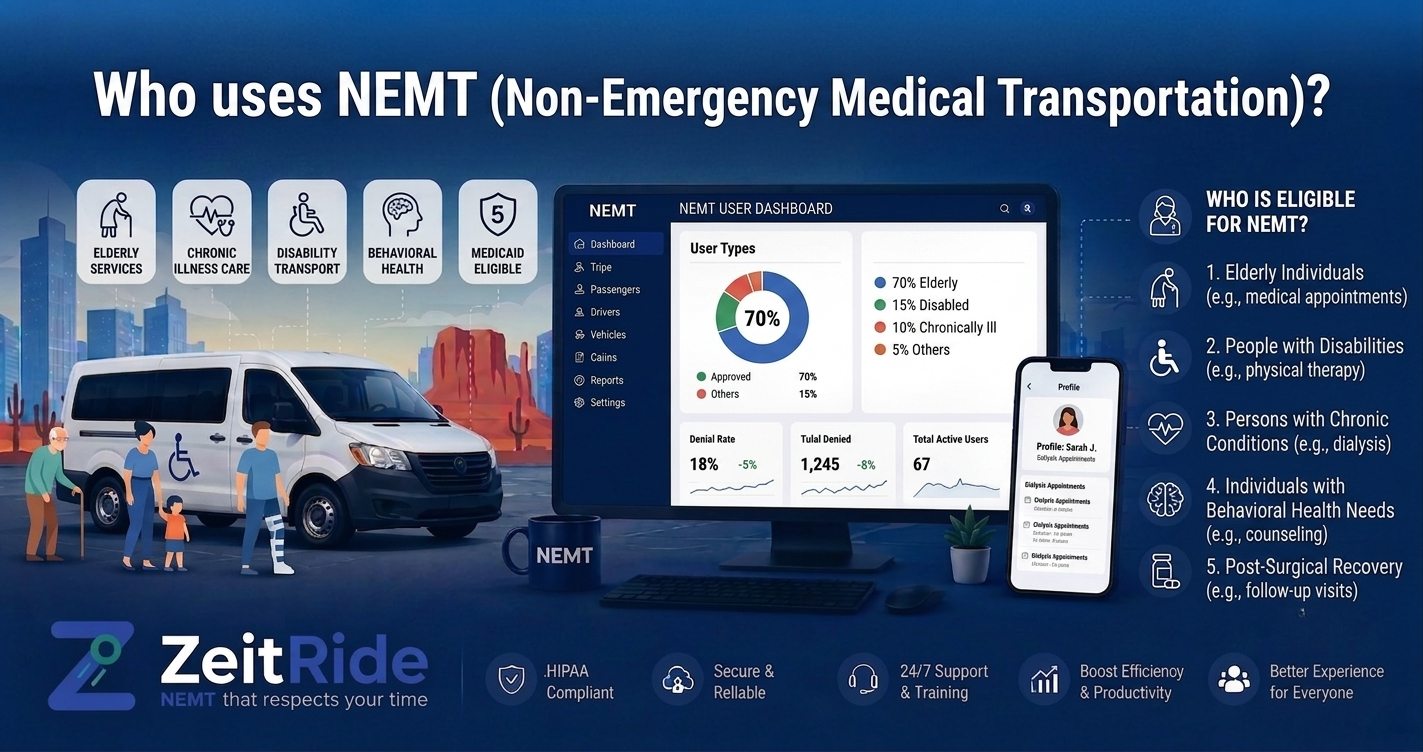
Who uses NEMT (Non-Emergency Medical Transportation)?
Who uses NEMT? Dialysis patients, wheelchair users, seniors & Medicaid riders — see what each means for your fleet, and how ZeitRide dispatches it all.
ZeitRide Team
NEMT Operations Expert
Who uses [NEMT (Non-Emergency Medical Transportation? Dialysis patients, wheelchair users, seniors without a safe way to drive, and Medicaid beneficiaries with no other route to care and every one of those riders puts a different demand on your fleet's scheduling, vehicle mix, and billing. ZeitRide runs NEMT dispatch, scheduling, routing, and billing on one $49-per-vehicle-per-month platform, so operators can match the right vehicle to the right rider without juggling three different tools.
What NEMT Riders Actually Need From Your Fleet
NEMT exists because a routine medical appointment can be out of reach without a ride — and the population that relies on it isn't one group, it's several, each with different equipment and scheduling needs.
- Dialysis patients — recurring rides, usually three times a week, at fixed treatment windows. A missed pickup here isn't an inconvenience, it's a missed treatment.
- Wheelchair users and people with mobility limitations — need lift-equipped or ramp vehicles and drivers trained in securement.
- Seniors (65+) — the largest single NEMT population, often needing help getting from the curb to the waiting room, not just a ride.
- Medicaid beneficiaries — covered under state Medicaid NEMT benefits, which require accurate trip records for broker reimbursement.
- Rural residents — traveling longer distances to reach specialists, which changes how routes and driver payroll get calculated.
- Patients recovering from surgery or procedures — typically short-term, ad-hoc trips rather than recurring routes.
Every one of these riders shows up in your dispatch queue as a different combination of vehicle type, trip frequency, and paperwork. That's the real operational question behind “who uses NEMT” — not just who rides, but what each rider type costs you to serve well.
How ZeitRide Handles Mixed Rider Populations
Legacy NEMT software often makes operators choose between recurring-route tools and ad-hoc dispatch tools, or charges extra for broker-specific formatting. ZeitRide runs all of it from one dispatch board.
- Recurring routes for dialysis, chemo, and physical therapy riders are scheduled once and repeat automatically, with built-in backup coverage if a driver calls out.
- Ad-hoc trips for post-surgical or one-off Medicaid rides drop into the same board without a separate module.
- Broker imports from MTM Health, Provide A Ride, ProCare, and DD Med Trans pull trip requests directly into dispatch, so nobody's re-typing manifests by hand.
- AI route optimization adjusts for wheelchair-equipped vehicles, rural distances, and appointment windows, averaging a 20% reduction in miles driven across a fleet.
- The driver app (iOS and Android, offline GPS, sub-15-minute learning curve) gives drivers the trip details, securement notes, and navigation they need without a second device.
Where Operators Get the Rider Mix Wrong
A lot of fleets size their vehicle mix around last year's contract instead of the population they're actually serving today. Two mistakes show up constantly: Under-investing in wheelchair-accessible capacity. Wheelchair users and dialysis patients often overlap, and a fleet running short on lift-equipped vehicles ends up turning away the highest-frequency, most reliable revenue on the books.
Treating recurring and ad-hoc trips the same way in scheduling. A dialysis patient's Tuesday-Thursday-Saturday slot needs a locked route with backup coverage. A one-time post-op ride doesn't. Dispatch software vs. a spreadsheet or a legacy per-trip tool like TripMaster tends to blur that distinction, which is exactly where missed pickups start.
ZeitRide's routing software separates recurring and ad-hoc logic automatically, and scheduling software flags conflicts before they become a missed dialysis run. Sandra Mills, Fleet Manager at SafeTrip NEMT, reported running three fewer vehicles per day while serving the same member count after switching to this structure.
There's a third mistake worth naming: pricing the whole fleet as if every rider costs the same to serve. A wheelchair-equipped vehicle running a recurring dialysis route has predictable mileage, predictable fuel cost, and a predictable revenue stream from broker reimbursement. An ambulatory vehicle covering ad-hoc rural trips has none of that predictability — longer average distances, more empty return legs, and slower broker turnaround on one-off requests. Operators who track cost per rider type, rather than a blended average across the whole fleet, tend to catch margin problems before they show up on a quarterly P&L. ZeitRide's billing software ties completed trips back to broker remittance automatically, so that kind of per-rider-type reporting doesn't require pulling data from three separate systems by hand.
NEMT Riders by State: Why Local Broker Relationships Matter
The rider population looks different depending on where you operate. A fleet running Medicaid trips in Pennsylvania deals with a different broker landscape and EVV mandate than one running in Florida, where seasonal snowbird populations and rural county coverage change trip volume month to month.
Operators expanding into new states need NEMT software that can onboard a new broker relationship without a re-implementation project. ZeitRide connects to broker networks active in 10+ states today, with HIPAA-aware, Medicaid-ready compliance and EVV support built in rather than bolted on. That matters most for operations directors managing electronic trip records across multiple state contracts, since audit requirements rarely look identical from one state to the next.
Bottom Line
Who uses NEMT comes down to a handful of overlapping groups — dialysis patients, wheelchair users, seniors, and Medicaid beneficiaries — each needing a slightly different combination of vehicle, schedule, and paperwork. Fleets that serve that mix well need dispatch, routing, and billing running from one system rather than three. ZeitRide operators are typically live and running their first route within a day, at $49 per vehicle per month, with no setup fees or contracts.
Frequently Asked Questions
Q: Who is eligible for NEMT (Non-Emergency Medical Transportation)?
Eligibility is typically determined by state Medicaid programs or private insurers, and generally covers people who lack another way to reach a covered medical appointment. Most riders are Medicaid beneficiaries, seniors, people with disabilities, or dialysis and chemotherapy patients whose treatment requires reliable, recurring transportation.
Q: What's the difference between NEMT and emergency medical transportation?
NEMT covers non-emergency trips like dialysis, physical therapy, or routine doctor visits, while emergency transportation (ambulances) responds to medical crises. NEMT software like ZeitRide handles scheduled and ad-hoc non-emergency trips, not 911 dispatch.
Q: Do NEMT vehicles need to be wheelchair accessible?
Not every vehicle in a fleet needs to be wheelchair accessible, but fleets serving dialysis and mobility-limited riders typically need a mix of ambulatory and lift-equipped vehicles. ZeitRide's dispatch board matches trip requests to the right vehicle type automatically based on rider needs entered at booking.
Q: How do NEMT brokers like MTM Health or Provide A Ride fit into dispatch?
Brokers assign Medicaid-covered trips to contracted NEMT providers and require accurate trip manifests for reimbursement. ZeitRide integrates directly with MTM Health, Provide A Ride, ProCare, and DD Med Trans, pulling broker trip requests straight into dispatch instead of requiring manual entry.
Q: What software do NEMT fleets use to manage different rider types?
Most fleets need NEMT software covering dispatch, scheduling, routing, and billing rather than separate tools for each. ZeitRide runs all four at $49 per vehicle per month, with recurring-route scheduling for dialysis-type riders and ad-hoc dispatch for one-off trips on the same board.
Rather see it than read about it?
Bring a real route, a couple of drivers, and your current process. 15 minutes, zero pitch.