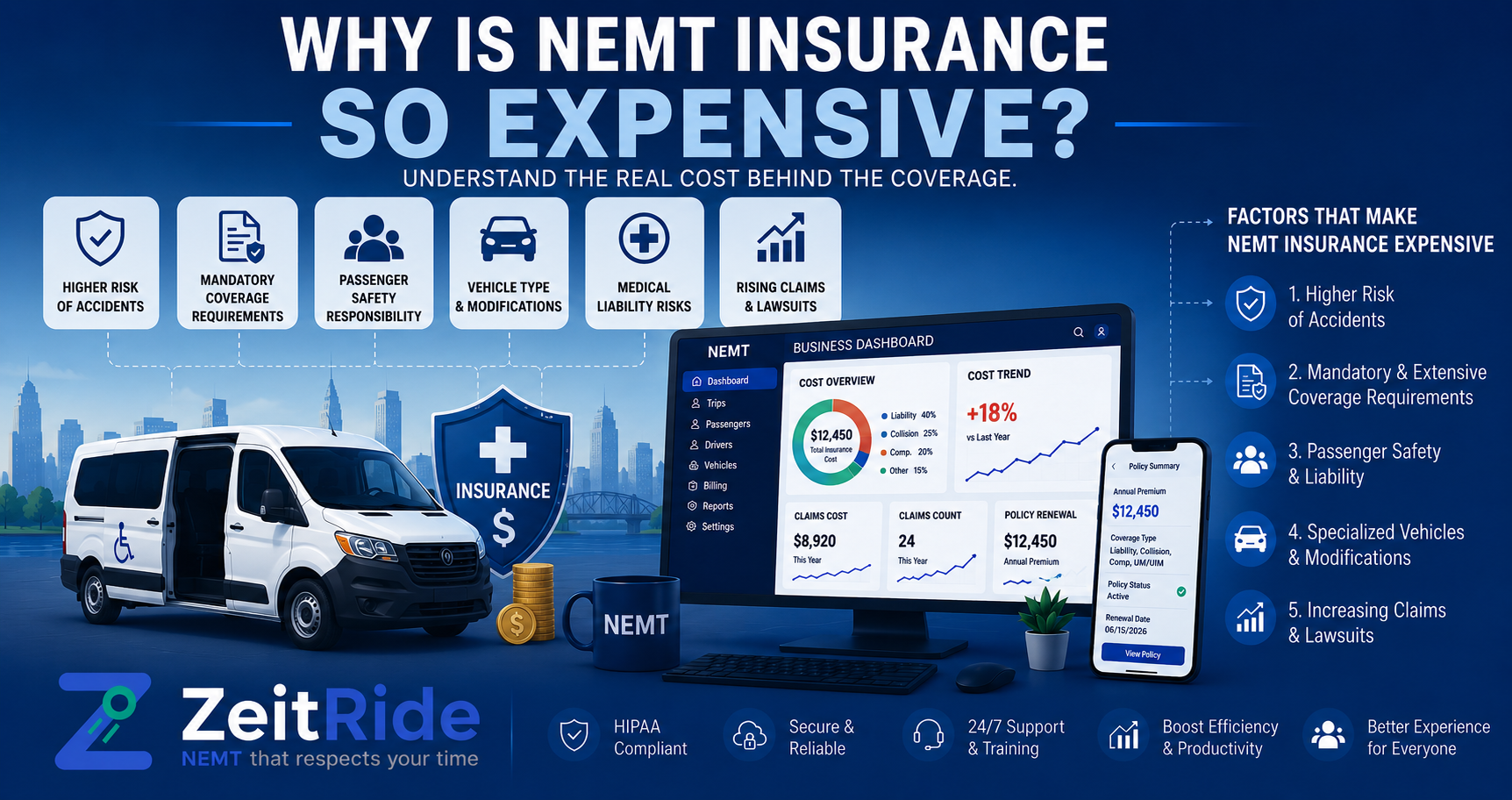
Why is NEMT insurance so expensive?
NEMT insurance is expensive due to high liability risk, medical transport requirements, strict regulations, and specialized vehicle coverage.
Quick answer
NEMT insurance is expensive because providers transport medically vulnerable passengers, which increases liability risk. Insurers also require higher coverage limits, specialized commercial policies, and compliance with state and Medicaid regulations, all of which raise overall premiums.
ZeitRide Team
NEMT Operations Expert
Why is NEMT insurance so expensive? Because insurers aren't pricing a delivery van they're pricing a mobile healthcare service carrying medically fragile passengers, and one bad claim from that population can run into six figures. NEMT insurance typically costs $6,000 to $16,000 per vehicle per year, two to three times more than standard commercial auto. We've seen this firsthand working with fleets across 10+ states on ZeitRide, the $49-per-vehicle NEMT dispatch platform that helps operators run cleaner, more auditable trips the exact kind of record insurers reward.
What's Actually Driving NEMT Insurance Costs Up
The short answer: passenger risk, equipment risk, and a thin carrier market all stack on top of each other. Standard commercial auto claims average around $12,000. NEMT injury claims average $150,000 or more, because the people in the seats are elderly, disabled, or recovering from medical procedures a minor fender bender that bruises a healthy adult can trigger a serious health decline in a dialysis patient.
On top of that, 40 to 60 percent of NEMT claims happen during loading and unloading, not while the vehicle is moving. A wheelchair tie-down failure or a fall on a ramp isn't a "driving" incident, which is exactly why standard non emergency medical transportation insurance requires specific loading-and-unloading endorsements that regular commercial auto policies don't include. Add the fact that only a small number of carriers nationwide actively write NEMT coverage, and you've got higher prices with less competition to push them down.
For new fleets, there's a third factor: no claims history means underwriters price for the worst case. That's why nemt insurance cost for a first-year operator typically runs 30 to 50 percent higher than for an established fleet with two clean years on the books.
How ZeitRide Helps Lower Your Real-World Risk
ZeitRide doesn't sell insurance, and we won't pretend a software platform changes your premium overnight. What it does change is the quality of the safety and compliance record you bring to a renewal conversation — and that record is exactly what brokers and underwriters ask for. Here's what that looks like day to day:
- AI route optimization cuts miles driven by an average of 20%, which means less time on the road and fewer exposure hours per trip
- GPS tracking through the driver app creates a verifiable mileage and location trail — the same kind of data brokers ask for when reviewing your loss runs
- Electronic trip records and trip manifests replace paper logs, so you have clean, timestamped documentation if a claim ever needs to be disputed
- EVV support and HIPAA-aware data handling keep you compliant with Medicaid broker requirements from MTM Health, Provide A Ride, ProCare, and similar partners
- Encrypted data in transit and at rest, with a 99.9% uptime target, so your records are actually there when an insurer or auditor asks for them
Sandra Mills, a fleet manager at SafeTrip NEMT, told us she's now running three fewer vehicles per day with the same member count fewer vehicles on the road with the same coverage is exactly the kind of efficiency that shows up favorably in a renewal review.
See exactly how ZeitRide handles trip documentation and compliance — no pitch, just your workflow on our platform.
NEMT Insurance vs. Standard Commercial Auto: What Operators Get Wrong
The biggest mistake new operators make is assuming a standard commercial auto policy covers them the same way NEMT insurance does. It doesn't. A standard policy typically stops at the curb if your driver helps a passenger down a ramp and they fall, that policy may not cover it at all, because it's neither a moving-vehicle accident nor a clean general-liability claim.
The second mistake is shopping for non emergency medical transportation insurance the way you'd shop for any commercial policy price first. Cheap quotes that skip the loading-and-unloading endorsement or the sexual abuse and molestation (SAM) rider that Medicaid brokers require can leave you with a denied claim that costs far more than the premium you saved.
The third mistake is treating nemt insurance brokers like generalist agents. A broker who handles NEMT accounts once or twice a year doesn't know which carriers actually want your risk profile. A specialist who works NEMT policies regularly typically has appointments with carriers a general agent can't access, and knows what safety documentation like the kind ZeitRide generates automatically actually moves the needle at renewal.
Who This Information Is For
This matters most to three roles inside your operation:
- Fleet owners trying to budget accurately for Year 1 instead of getting blindsided by a $12,000-per-vehicle quote
- Operations directors who need to show clean safety and compliance records to brokers at renewal time
- Dispatch coordinators whose day-to-day routing and trip data quietly becomes the evidence base for your next insurance conversation
If you're in any of these seats, the conversation with your nemt insurance brokers gets a lot easier when you can hand them real mileage data, route history, and trip records instead of a shoebox of paper logs.
NEMT Insurance Cost Varies Sharply by State
Where you operate matters almost as much as what you drive. States with heavier litigation environments or stricter labor laws tend to push non emergency medical transportation insurance cost well above the national range, while rural, lower-litigation states sit closer to the floor.
Pennsylvania operators, for example, deal with a mix of urban Philadelphia/Pittsburgh density and large rural service areas fleets running both need routing software that can handle long, mixed-mileage routes without inflating declared mileage on insurance paperwork. ZeitRide's NEMT software for Pennsylvania operators is built around exactly that mix.
Florida is one of the harder markets nationally for NEMT insurance, driven by no-fault PIP laws and a heavier litigation climate, and several standard carriers have pulled back from the state. Operators there lean even more on dashcam and telematics-style documentation to keep premiums manageable something our Florida NEMT software covers in more detail, including broker integrations active in the state.
Bottom Line
NEMT insurance is expensive for real, structural reasons — fragile passengers, specialized equipment, and a thin pool of carriers willing to write the risk at all. You can't change those underlying facts, but you can control the documentation and safety record you bring to every renewal. ZeitRide runs that record automatically: route optimization that cuts miles by 20%, GPS-verified trip data, and EVV-ready compliance, all for $49 per vehicle with no setup fees or contracts.
Start your first live route within a day. $49/vehicle. No contracts. Book your demo.
Frequently Asked Questions
Q: Why is NEMT insurance so expensive compared to regular commercial auto?
NEMT insurance costs more because it covers medically fragile passengers, not standard cargo or commercial deliveries. Average NEMT injury claims run $150,000 or higher, against roughly $12,000 for standard commercial auto, and that severity gap is baked directly into every quote you get.
Q: What's the average non emergency medical transportation insurance cost per vehicle?
Most operators pay between $6,000 and $16,000 per vehicle per year, depending on vehicle type, state, and claims history. Wheelchair-accessible vans typically cost more than ambulatory sedans because of the added equipment liability.
Q: What are the basic non emergency medical transportation insurance requirements?
At minimum, you need commercial auto liability (often $1 million combined single limit), general liability, and in most states workers' compensation. Medicaid broker contracts from companies like MTM Health or Provide A Ride often add their own requirements on top, including loading-and-unloading endorsements and SAM riders.
Q: Can software actually lower my nemt insurance cost?
Software doesn't set your premium, but the documentation it generates — GPS-verified mileage, trip manifests, electronic trip records — gives brokers and underwriters the evidence they need to justify lower rates at renewal. Operators using ZeitRide's route optimization also log fewer miles per trip, which directly reduces road exposure.
Q: Should I work with nemt insurance brokers or go direct to a carrier?
If you're a solo operator with a clean driving record needing only state-minimum coverage, a direct carrier can work. Once you're running multiple vehicles or need Medicaid broker compliance, a specialist among nemt insurance brokers usually gets you better placement and pricing than a generalist agent.
Rather see it than read about it?
Bring a real route, a couple of drivers, and your current process. 15 minutes, zero pitch.