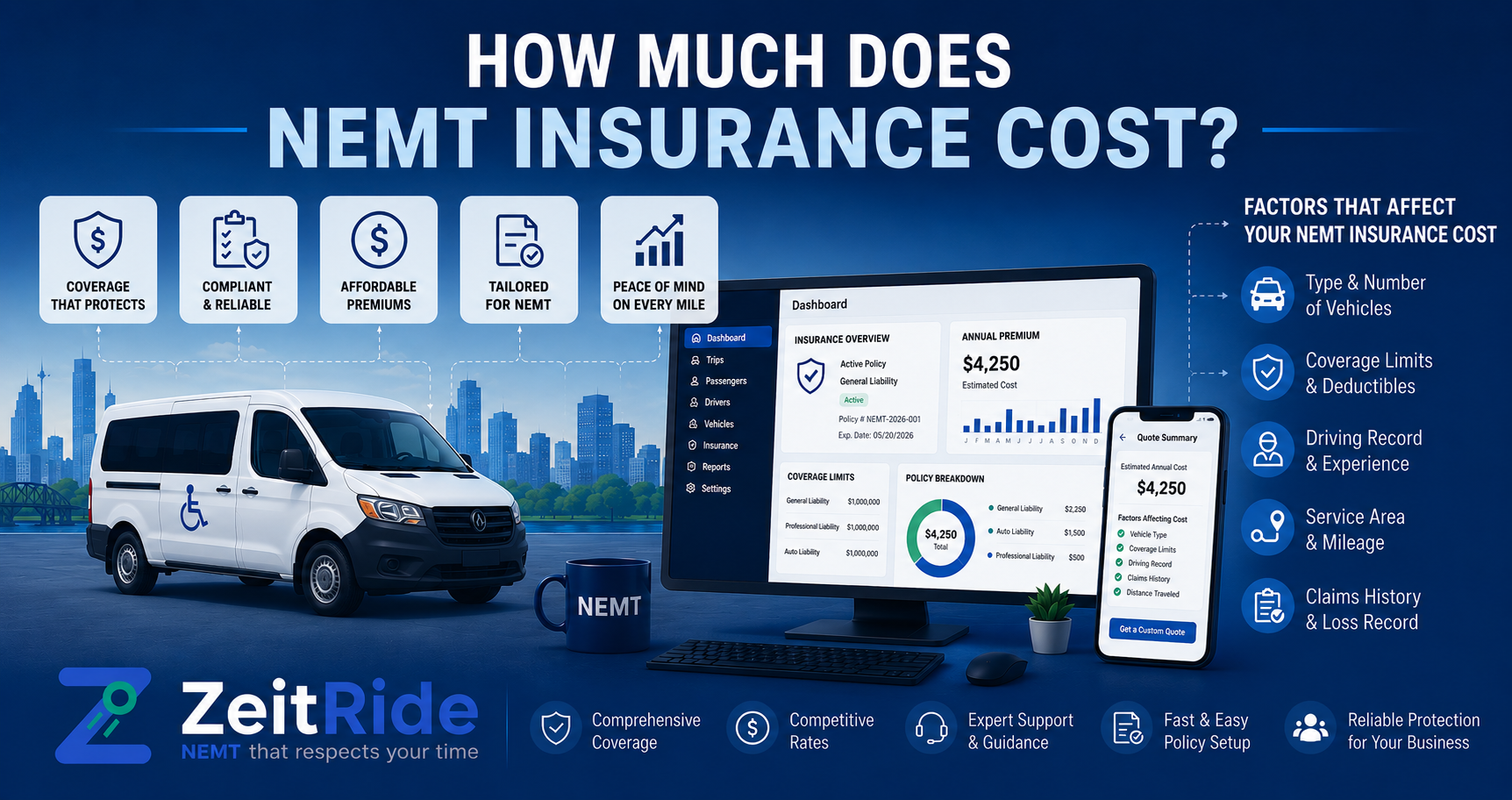
How Much Does NEMT Insurance Cost?
Virginia NEMT insurance costs $5,500–$16,000/vehicle/year. Learn what drives your premium and how to reduce it as a Virginia operator in 2026.
Quick answer
Virginia NEMT operators typically pay $5,500–$9,000/year per sedan, $7,500–$13,500 for wheelchair vans, and $9,000–$16,000 for stretcher vans. Virginia's state minimum liability requirement is $350,000, with coverage options up to $5,000,000.
ZeitRide Team
NEMT Operations Expert
NEMT insurance is one of your biggest fixed costs and most operators don't know what they're really paying for or why. In Virginia, where Medicaid transportation runs through managed care organizations with their own coverage minimums, getting this wrong can disqualify your fleet from contracts entirely. This guide breaks down exactly how much
NEMT insurance costs in 2026, what drives your premiums up, and how operators running lean with the right dispatch software and operations systems pay less over time. ZeitRide fleets reduce miles driven by an average of 20% and fewer miles on the road means lower exposure at renewal.
How Much Does NEMT Insurance Cost in Virginia?
NEMT insurance cost in Virginia ranges from $6,500 to $18,000 per vehicle annually, depending on vehicle type, your fleet's loss history, the region you operate in, and whether your contracts run through DMAS directly or through a managed care organization (MCO) like Anthem HealthKeepers, Molina Healthcare, or Aetna Better Health of Virginia.
Here's a practical starting point by vehicle type and operator status:
Why NEMT Insurance Is So Expensive
Most operators get their first insurance quote and assume the number is fixed. It isn't. What you pay is a direct function of how your operation looks to an underwriter — and that's something you can influence from day one.
The four biggest cost drivers in Virginia:
1. Passenger vulnerability. Your passengers are dialysis patients, stroke survivors, and wheelchair users. A fender-bender that causes a bruise on a healthy adult can result in a six-figure settlement involving a medically fragile passenger. Insurers price NEMT separately from standard commercial auto for exactly this reason.
2. High annual mileage. A NEMT vehicle completing 8–12 trips per day accumulates 50,000–80,000 miles annually. That's two to three times what most commercial fleet vehicles log. More miles equal more exposure, and insurers calculate premiums partly on miles-driven projections.
3. Driver turnover. High turnover is common in NEMT. Every new driver is an unknown risk. Operators who document driver screening processes — MVR checks at hire and annually, CPR certification tracking, defensive driving completion — present a stronger risk profile at renewal than operators who can't produce those records.
4. Virginia's MCO credentialing requirements. If you're contracted with Anthem HealthKeepers Plus, Molina Healthcare of Virginia, or Aetna Better Health, their credentialing packets often require higher liability limits than the Virginia DMAS baseline. Some MCOs require $2,000,000 per occurrence in commercial auto liability — double what many new operators budget for.
What Coverage Does a Virginia NEMT Fleet Actually Need?
NEMT insurance isn't a single policy. It's a stack of coverages, and Virginia operators need all of them to be contract-eligible:
- Commercial auto liability — Virginia DMAS requires a minimum of $1,000,000 per occurrence. MCO contracts frequently require $1,500,000 – $2,000,000.
- General liability — Covers non-vehicle incidents: a passenger falling during transfer, a wheelchair tipping during loading. Standard is $1,000,000 per occurrence / $2,000,000 aggregate.
- General liability — Covers non-vehicle incidents: a passenger falling during transfer, a wheelchair tipping during loading. Standard is $1,000,000 per occurrence / $2,000,000 aggregate.
- Uninsured / underinsured motorist — Required in Virginia. Protects your passengers when an at-fault driver doesn't carry adequate coverage.
- Workers' compensation — Mandatory the moment you hire a W-2 driver in Virginia. Covers on-the-job injuries during patient loading, ramp operation, and vehicle operation.
Do not attempt to operate a NEMT contract under standard commercial auto insurance. It doesn't cover your passenger liability exposure, and it violates broker and MCO credentialing agreements.
How ZeitRide Helps Lower Your Insurance Risk Profile
The connection between your dispatch software and your insurance cost is direct — and most competitors never explain it. Here's how it works:
Insurers evaluate your renewal based on:
- Claims history (accidents, injuries, near-misses)
- Compliance documentation (driver records, certifications, trip logs)
- Billing accuracy (audit exposure from duplicate trips, incorrect coding)
- Mileage patterns (more miles = higher exposure)
ZeitRide addresses all four:
- Route optimization reduces miles driven by an average of 20%. Fewer miles mean less exposure per vehicle per year — which directly supports a lower per-vehicle premium at renewal.
- HIPAA-aware, Medicaid-ready billing keeps your trip documentation clean. Billing errors attract Medicaid audits; audits surface compliance gaps; compliance gaps raise red flags with your insurer.
- EVV support ensures every trip is electronically verified, reducing disputes and documentation gaps that create claim exposure.
- iOS and Android driver app with offline GPS support maintains accurate trip-level records even in rural Virginia areas where connectivity drops — so your logs hold up under scrutiny.
- Broker integrations with MTM Health, CTS Transit, Provide A Ride, ProCare, and DD Med Trans ensure your billing and documentation meet broker requirements, reducing contract compliance risk.
One ZeitRide operator reduced daily fleet usage by three vehicles after implementing route optimization. That's three fewer vehicles on the road, three fewer policies renewing, and three fewer potential liability exposures every day.
Common Mistakes That Push Your NEMT Insurance Cost Higher
Most premium overruns are preventable. Here's where operators consistently pay more than they should:
Buying standard commercial auto instead of NEMT-specific coverage. It seems cheaper upfront. It's not — and when an MCO audits your credentialing, you're immediately out of compliance.
Using a generalist broker. Generalist brokers place NEMT accounts with standard commercial carriers who load additional "specialty risk" fees onto unfamiliar industries. A NEMT-specialist broker has established relationships with underwriters who understand your business and price accordingly. The difference can be 10–20% at renewal.
Financing premiums monthly without accounting for the surcharge. Monthly payment plans add 5–12% to your total annual cost. On a $50,000 annual premium across a 10-vehicle fleet, that's $2,500 – $6,000 extra per year — money that disappears without improving your coverage.
Running operations on spreadsheets or legacy software. If your trip records, driver certifications, and billing history aren't centralized and auditable, your broker can't present a clean operational profile to underwriters. That means you're priced at generic risk rates instead of preferred-operator rates.
Who ZeitRide Is Built For
ZeitRide is built for NEMT operators running 5 to 100+ vehicles who are done paying for software that wasn't designed for this industry.
If any of these describe your operation, ZeitRide is worth a look:
- You're managing dispatch across multiple drivers and the process still involves phone calls and spreadsheets
- Your billing takes a full day of admin work that could be automated
- You're contracted with one or more Medicaid brokers and managing those integrations manually
- Your fleet usage is higher than it should be because you're not routing efficiently
- You want to be live on a new system fast — ZeitRide providers are live within 30 minutes, with a first route within one day
- You want predictable pricing — $49/vehicle/month, no setup fees, no per-trip fees, no contracts
Virginia-Specific NEMT Insurance Challenges
Virginia's NEMT market has structural characteristics that affect what you pay and what coverage you need.
Northern Virginia fleets (Fairfax, Arlington, Prince William, Loudoun counties) operate in high-traffic, high-density corridors. Urban premium loading adds 15–25% to per-vehicle rates compared to rural baselines. Accident frequency is higher, claim costs are higher, and insurers price accordingly.
Rural Southwest and Southside Virginia fleets face different pressures: lower accident frequency but dramatically higher mileage per trip. A fleet serving Russell County or Halifax County may log 80,000+ miles per vehicle annually on long-distance rural runs. Per-mile exposure matters as much as per-trip frequency in rural operations.
DMAS vs. MCO contract requirements. Virginia's Medicaid managed care system means your coverage requirements depend on who manages your members' transportation benefit. Fleets working exclusively through DMAS have different minimums than those contracted with all three major Virginia MCOs simultaneously. If you operate under multiple contracts, you need to meet the highest minimum across all of them.
EVV compliance. Virginia requires Electronic Visit Verification for certain Medicaid transportation services. EVV-compliant documentation isn't just a billing requirement — it's also a risk management tool. ZeitRide's EVV support ensures every trip is logged and verifiable, which strengthens your documentation posture at insurance renewal.
Conclusion
NEMT insurance cost is one of the largest fixed expenses in your operation, and in Virginia it's shaped by MCO contract requirements, fleet mileage exposure, and your documentation posture at renewal. In 2026, Virginia operators are paying $6,500 – $18,000 per vehicle annually with new operators at the high end and established fleets with clean loss history paying significantly less.
The primary keyword question how much does NEMT insurance cost doesn't have one answer, but it has a predictable one: operators who run tighter routes, cleaner documentation, and compliant billing consistently pay less over time. ZeitRide fleets reduce miles driven by 20% on average, which directly reduces your annual mileage exposure and strengthens your renewal profile. At $49/vehicle/month with no setup fees and no contracts, your software cost is the one line item you won't be renegotiating.
Frequently Asked Questions
How much does NEMT insurance cost per month?
NEMT insurance cost per month typically runs $585 – $875/month for a single sedan operated by a new Virginia operator, and $790 – $1,165/month for a wheelchair accessible vehicle. Established operators with three or more years of clean loss history pay 20–30% less.
How much does NEMT insurance cost in Virginia specifically?
In Virginia, NEMT insurance averages $6,500 – $18,000 per vehicle annually depending on vehicle type, loss history, and whether you're contracted through DMAS or a managed care organization. Northern Virginia operators in metro corridors pay toward the higher end due to urban premium loading. Rural Virginia operators often pay mid-range rates but face higher mileage exposure per vehicle.
What is the average cost of NEMT insurance per month across the US?
The national average NEMT insurance cost per month runs $540 – $1,165 per vehicle depending on type and operator experience. WAVs cost more to insure than sedans because wheelchair and stretcher securement failures create higher injury risk. New operators pay a 25–40% surcharge over market rate in Year 1.
Does NEMT insurance cost vary by state?
Yes, significantly. Virginia falls in the mid-range nationally. States like California and New York carry higher minimums and urban risk loading. States like Idaho and Montana have lower base rates. Within Virginia, MCO-specific credentialing requirements create another layer of variation — an operator running three MCO contracts simultaneously may face different minimum liability requirements on each one. A NEMT-specialist broker can navigate this; a generalist broker often can't.
Rather see it than read about it?
Bring a real route, a couple of drivers, and your current process. 15 minutes, zero pitch.