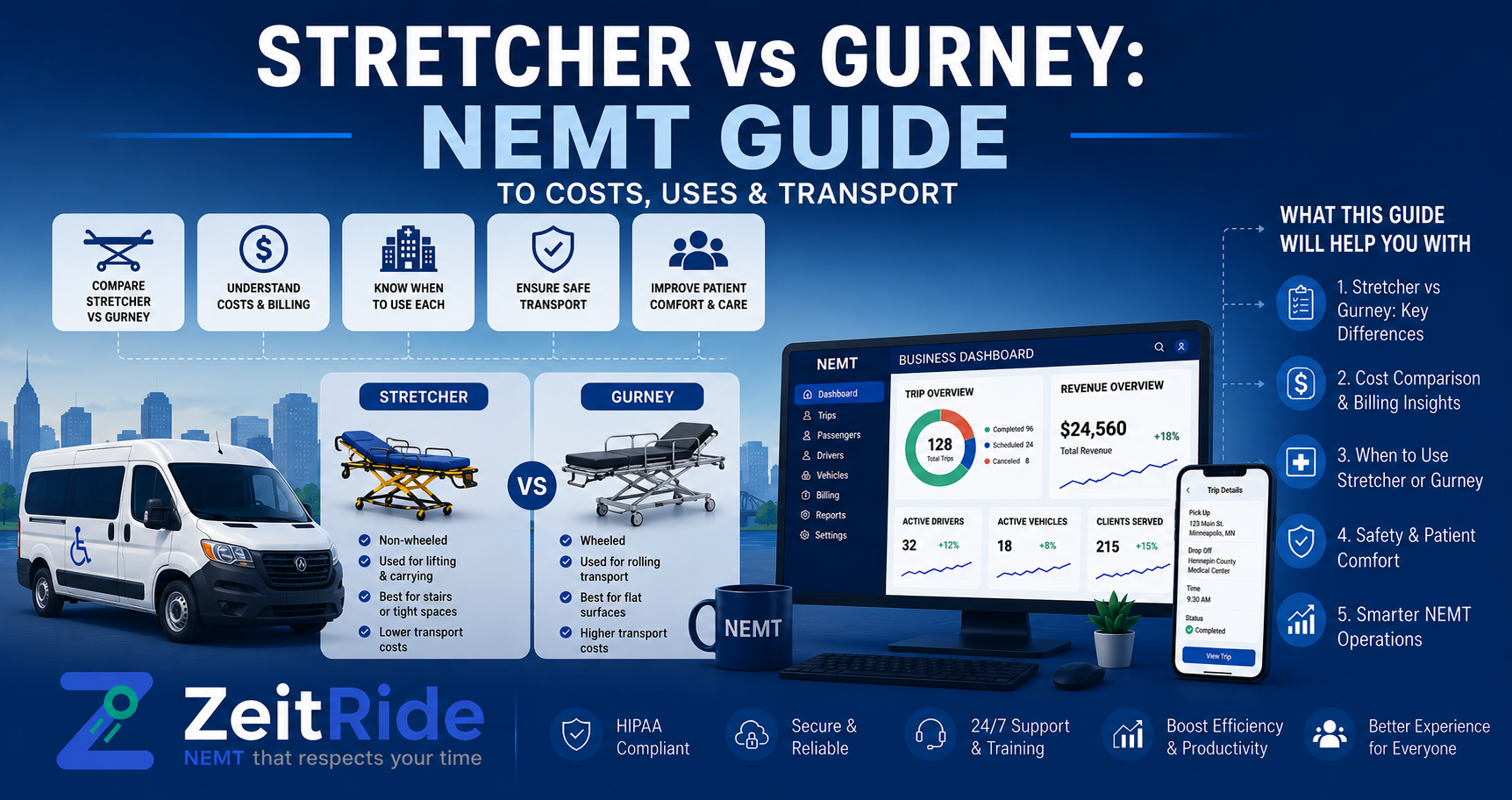
Stretcher vs Gurney: NEMT Guide to Costs, Uses & Transport
Learn the key differences between stretcher and gurney transport in NEMT, including uses, costs, billing impact, and scheduling considerations.
Quick answer
Stretcher vs gurney in NEMT describes two patient transport types: stretchers are portable and often require manual lifting, while gurneys are wheeled transport beds. Gurney trips require more staffing, vehicle setup, and higher reimbursement rates.
ZeitRide Team
NEMT Operations Expert
Stretcher vs gurney is one of those questions that sounds simple until you're trying to staff a return trip, assign the right vehicle, or explain a reimbursement discrepancy to a broker. For NEMT operators running 5 to 100+ vehicles, the distinction affects scheduling windows, driver certification requirements, vehicle utilization, and billing codes, not just which piece of equipment rolls into the van.
ZeitRide helps fleets across 10+ states manage exactly these workflows, cutting average miles driven by 20% through AI-powered routing. Book a 15-minute demo, bring a real route and we'll run it live in ZeitRide.
What Is the Difference Between a Stretcher and a Gurney?
The difference between a gurney and a stretcher comes down to mobility, clinical design, and what they demand from your staff and vehicles.
A patient stretcher is a flat, portable platform built for moving patients who can't walk or sit upright. Most traditional stretchers require two caregivers to lift and carry the patient — they don't roll independently and offer minimal adjustment. They're lighter, cheaper, and faster to deploy in emergencies, but they put more physical strain on transport staff during longer or more complex trips.
A patient gurney — sometimes called a gurney stretcher — is a wheeled transport system engineered for movement through hallways, parking lots, and vehicle loading ramps. Medical gurneys include:
- Integrated locking wheels
- Adjustable height controls (reduces caregiver back strain)
- Collapsible side rails for patient safety
- Shock-absorbing frames for smoother rides
- Weight ratings suited for bariatric patients in many models
For NEMT purposes, the core functional difference is this: a stretcher requires your crew to do more lifting; a gurney lets the equipment do more of the work.
What Is a Gurney Transport — and How Does It Affect Your Billing?
Gurney transport is a specialized NEMT service category where a patient rides in a fully reclined position on a wheeled medical gurney inside a vehicle purpose-built for that configuration.
This matters for your bottom line because Medicaid brokers and managed care organizations classify gurney transport separately from ambulatory and wheelchair trips — and they reimburse at a higher rate. Patients who qualify typically include:
- Bed-confined patients who cannot safely sit upright
- Post-surgical patients with wound, drain, or positional restrictions
- Dialysis patients with severe weakness or vascular access complications
- Hospice patients in palliative care
- Patients recovering from orthopedic surgery, strokes, or major trauma
When a broker trip is coded as gurney transport, the vehicle must be configured to accommodate the gurney fully reclined, the driver must often hold additional certification, and the trip documentation — including EVV data and trip manifests — must reflect the service level accurately.
Misclassifying a gurney trip as a wheelchair trip (or vice versa) doesn't just create a compliance problem. It either leaves reimbursement on the table or triggers an audit. Accurate NEMT billing requires that your software captures the service type at the trip level, not as an afterthought at invoice time.
What NEMT Operators Get Wrong About Stretcher or Gurney Transportation
Most operators focus on the upfront equipment cost and stop there. That's the wrong calculation.
Here's what actually drives profitability on gurney ambulance and stretcher trips:
Scheduling windows are tighter. A standard ambulatory pickup takes 5–10 minutes. A gurney load — securing the patient, locking the gurney, confirming positioning — takes 15–25 minutes. If your dispatcher schedules a gurney trip with the same time buffer as a wheelchair trip, the entire day's route gets compressed.
Vehicle assignments are non-negotiable. Not every van in your fleet can run a gurney trip. If your dispatch software doesn't flag vehicle capability at the assignment stage, a driver shows up in the wrong vehicle. Now you've got a patient waiting, a missed appointment window, and a potential broker penalty.
Return trips require coordination your dispatchers can't do manually at scale. A patient going to dialysis at 7 AM needs a return window that fits their treatment time — often 3–4 hours later, sometimes longer. Manually tracking that across 20+ active trips in a day is where things fall apart. We've seen operators across 10+ states lose revenue not because of bad equipment, but because dispatchers were coordinating complex stretcher and gurney trips using spreadsheets and phone calls.
Certification gaps create exposure. Some states require additional driver training for gurney transport. If your scheduling system doesn't track driver certifications and automatically match qualified drivers to gurney trips, you're relying on a dispatcher to remember — and that's not a system, that's a risk.
ZeitRide's NEMT dispatch software handles vehicle capability filtering, driver certification matching, and return-trip scheduling in one platform. One fleet manager — Sandra Mills at SafeTrip NEMT — cut three vehicles from her daily operation while maintaining the same member volume, largely because automated routing stopped sending the wrong vehicles on the wrong trips.
See exactly how ZeitRide handles gurney trip dispatching and scheduling — no pitch, just your workflow on our platform.
Stretcher vs Gurney: Cost Breakdown for NEMT Operators
Neither a patient stretcher nor a medical gurney is cheap when you factor in the full operational picture. Here's how the costs compare:
Patient Stretcher Costs
- Equipment: $300–$1,500 depending on model and weight rating
- No major vehicle modification required in most cases
- Lower reimbursement classification in most Medicaid broker contracts
- Requires two-person crew for loading — staffing cost applies
Patient Gurney Costs
Equipment: $1,500–$8,000+ for ambulance-grade or bariatric models
Vehicle modification: floor-mounted locking tracks, interior clearance requirements
Higher Medicaid and broker reimbursement rates for qualified trips
Ongoing maintenance: wheels, rails, hydraulic systems
The math often favors investing in gurney capability if your market has consistent demand for bed-confined or post-surgical transport. The higher per-trip reimbursement can offset equipment and modification costs within months for a fleet running 10+ gurney trips per week.
What doesn't show up in that calculation is the operational cost of managing those trips without the right software. See ZeitRide's pricing — at $49 per vehicle per month with no setup fees and no contracts, the platform cost is a fraction of what operators typically lose in manual scheduling errors and missed billing on complex trips.
Who Should Be Making This Decision
The stretcher or gurney question isn't just a clinical call — it involves your whole operation.
Fleet Owners need to evaluate whether their local market supports gurney transport volume before spending $5,000–$10,000 on vehicle modifications. Check what your active brokers — MTM Health, Provide A Ride, ProCare — are actually sending you in terms of trip types before committing to configuration changes.
Dispatch Coordinators need software that surfaces the trip type, required vehicle configuration, and driver certification in a single view — before the trip is assigned, not after the driver arrives. ZeitRide's scheduling software centralizes that visibility across your entire active queue.
Operations Directors need trip-type data rolled up into utilization and reimbursement reports. If you can't see what percentage of your gurney-capable vehicles are running gurney trips vs. standard trips, you can't make a rational decision about whether to expand, reduce, or redeploy that capacity.
Drivers using ZeitRide's iOS and Android driver app see their full manifest — including trip type, patient positioning requirements, and any special instructions — before they leave the yard. The app has a sub-15-minute learning curve, which matters when you're onboarding drivers who aren't tech-native.
Caregivers and Case Managers should document whether a patient requires ambulatory, wheelchair, stretcher, or gurney transport clearly in the referral. Ambiguous referrals create classification errors that ripple through billing and compliance.
Conclusion
The stretcher vs gurney decision is ultimately about matching the right equipment to the patient's clinical needs but for NEMT operators, it doesn't stop there. Gurney transport requires the right vehicles, certified drivers, accurate billing codes, and scheduling workflows that account for longer load times and coordinated return trips.
Most operators who struggle with gurney trip profitability aren't failing on equipment they're failing on execution. ZeitRide helps fleets across 10+ states tighten that execution: AI routing cuts average miles by 20%, broker integrations with MTM Health, Provide A Ride, and ProCare reduce manual entry, and the whole platform runs at $49 per vehicle per month. Start your first live route within a day. No contracts. Book your demo.
Frequently Asked Questions
Q: Is a stretcher the same as a gurney?
Is a stretcher the same as a gurney? No. A gurney includes integrated wheels, adjustable height settings, locking mechanisms, and safety rails. A stretcher is a simpler, more portable platform that typically requires manual lifting by two caregivers. In NEMT, the distinction affects vehicle requirements, staffing, and broker billing codes.
Q: What is a gurney transport service?
Gurney transport is a specialized NEMT service where a patient rides fully reclined on a wheeled medical gurney inside a purpose-equipped vehicle. It applies to bed-confined, post-surgical, hospice, and other patients who cannot safely sit upright. Brokers like MTM Health and Provide A Ride classify and reimburse gurney transport at a higher rate than standard trips.
Q: Which is better for NEMT — a stretcher or a gurney?
Neither is universally better. A patient stretcher works for shorter transfers where full positional stability isn't required. A patient gurney is the safer and more practical choice for longer trips, higher-acuity patients, and any situation where caregiver ergonomics and patient comfort are priorities. Most NEMT fleets serving a range of patient types carry both.
Q: How does gurney transport affect NEMT scheduling?
Gurney trips require longer loading windows (15–25 minutes vs. 5–10 for ambulatory), specific vehicle assignments, and coordinated return-trip scheduling. Without software that accounts for those variables, one delayed gurney trip can compress an entire day's route. ZeitRide's AI route optimization builds those time buffers in automatically and flags vehicle-type mismatches before assignment.
Q: What software helps manage gurney and stretcher trips efficiently?
NEMT dispatch software that tracks vehicle configuration, driver certifications, trip type, and return-trip windows in one platform. ZeitRide covers all of those workflows at $49 per vehicle per month — no setup fees, no per-trip fees, no contracts. Most providers are live within 30 minutes and running their first route within a day.
Rather see it than read about it?
Bring a real route, a couple of drivers, and your current process. 15 minutes, zero pitch.